

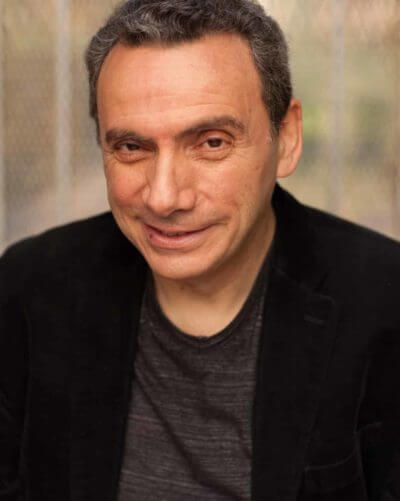
Image: Paolo Tatafiore, pianist
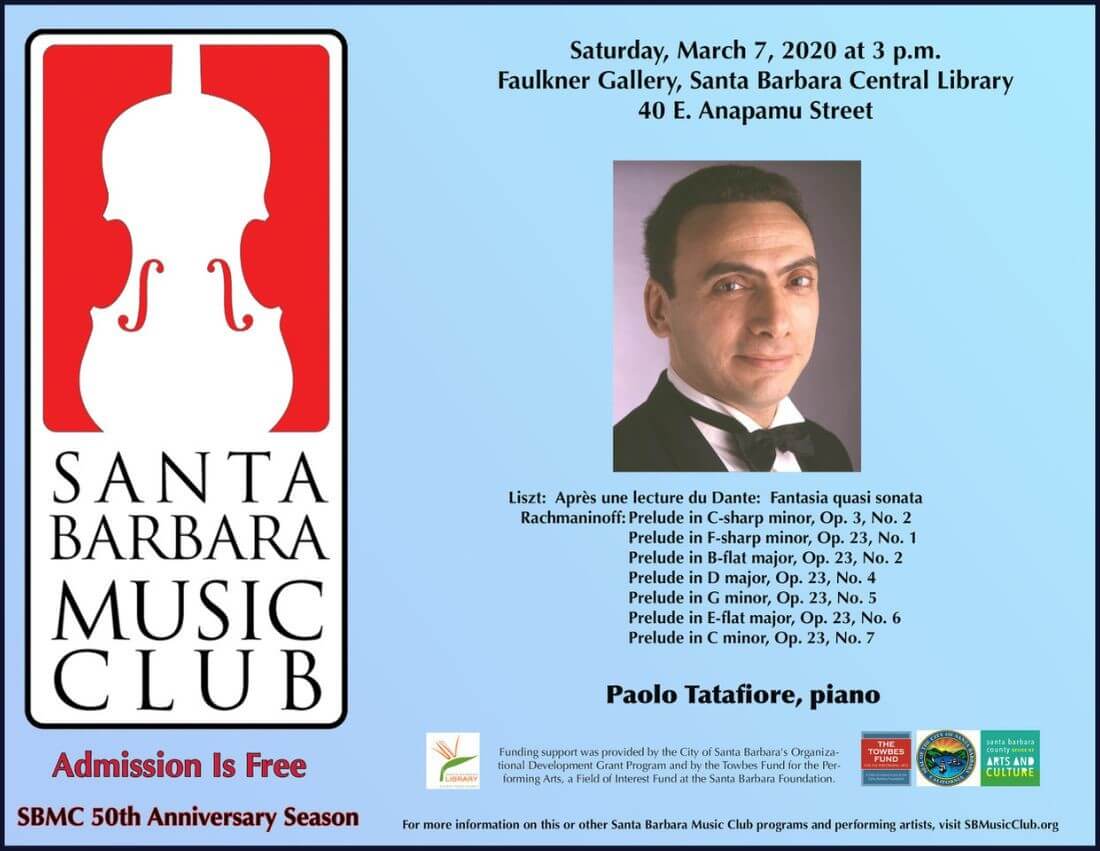
On Saturday, March 7 at 3 p.m. the Santa Barbara Music Club will present another program in its popular series of concerts of beautiful Classical music. Pianist Paolo Tatafiore highlights the reaches of piano technique and expression with Après une lecture de Dante: Fantasia quasi sonata, affectionately known as the “Dante Sonata” by Franz Liszt, as well as selections of Rachmaninoff’s preludes. This concert, co-sponsored by the Santa Barbara Public Library, will be held at the Faulkner Gallery of the library, 40 East Anapamu, Santa Barbara. As always, admission is free!
Program Details
Notes on the Program
Many of us have heard the tale before: around 1830, a young Franz Liszt (1811–1888) witnessed a performance by the virtuoso violinist Niccolo Paganini (1782–1840). Life for the emerging pianist was never the same. So dazzled was Liszt by Paganini’s musical and technical command of the violin that he obsessively dedicated himself to piano study in the hopes he could do for the piano what Paganini had done for the violin. What this tale doesn’t tell us, however, is how Liszt learned from Paganini and his years of study the ability to integrate virtuosity with formal organization and development. The virtuosity constitutive of Liszt’s piano music tends to grab our immediate attend, sometimes at the expense of recognizing the melodic and motivic invention in his compositions. And virtuosity often receives the most criticism, as its practitioners run the risk of devolving musical performance into empty brilliance, grandstanding, and artifice – where musical expression becomes a vehicle for the capabilities of the performer.
Not so with Liszt, though historians over the years have dithered back and forth over the validity of his contributions to piano literature on the basis of their technical difficulty. Yet Liszt lays bare seemingly otherworldly virtuosity and remarkable compositional craft in his set of three piano suites, Années de pèlerinage (Years of Pilgrimage). Liszt composed the suites mostly between approximately 1835 and 1839 with several reworkings thereafter. Today we hear the last piece from Book II, the Italian pilgrimage: the famous “Dante Sonata,” or Après une lecture de Dante: Fantasia quasi sonata. Liszt wrote the piece in 1839 and revised it ten years later.
Paolo Tatafiore’s performance of the “Dante Sonata” reveals the deep thought and work Liszt poured into his craft. While it is a single-movement fantasy-sonata, it also captures the essence of a multi-movement sonata cycle. In other words, one can analyze the single movement as one long three-part movement in sonata-allegro form—an exposition of introductory, main, and secondary themes; the development of those themes; and a recapitulation of the themes at the end. Yet one also can divide the piece into four smaller sections, each one emulating the typical movements of a classical sonata by, say, Beethoven. As if this form-within-a-form scheme weren’t impressive enough, Liszt fuses together his newly developed piano technique with the Beethovenian practice of taking small rhythmic, melodic ideas and building a large-scale form around them. Liszt uses the compositional technique of variation, a perfect vehicle to flex one’s virtuosic muscles while retaining the same melodic material, to sustain the work. Indeed, the “Dante Sonata” required as much compositional invention as this, because Liszt in essence gave to us his sonic interpretation of Dante’s The Divine Comedy.
Tatafiore concludes this afternoon’s performance with the music of another virtuoso, Sergey Vasilyevich Rachmaninoff (1873–1943), Prelude in C# Minor, Op. 3, No. 2, and selections from Preludes op. 23: Nos.1 in F# minor, 2 in Bb major, 4 in D major, 5 in G minor, 6 in Eb major, and 7 in C minor. Much like the Liszt-Paganini story, a history surrounds Rachmaninoff and his beloved C#-minor prelude. He wrote the piece at a mere 19 years of age and premiered it on 26 September 1892. To its credit, the prelude garnered the attention of teachers, colleagues, and critics, and it put Rachmaninoff on the map. Yet, as the composer mused throughout his life, the prelude haunted him. It became one of the only pieces—certainly the most popular—for which the composer was known. Audiences constantly asked for and requested the piece during performances. Yet for as much as it proved a perennial thorn in the side of the composer, the prelude intimated much of what Rachmaninoff would compose throughout his life. The piece opens with dark sonorities while loud bass tones interrupt a seeming endless line of soft chords in the mid-register of the piano, as if the agitation and virtuosity of the middle section is trying to break free. The middle and final sections relay one of Rachmaninoff’s staple pianistic techniques. He increases both the tempo and virtuosity until the music almost collapses under its own momentum, followed by an unrelenting progression of thick chords in both hands while jumping to opposite ends of the piano.
Many of the stylistic traits found in the Prelude in C# Minor surface to a higher degree of development and exploration in the Op. 23 Preludes. For example, Rachmaninoff sustains a beautiful melodic line over a listless and anxiety-laden accompaniment in the first prelude in F# minor, while Nos. 2 in Bb and 5 in G minor both convey a sense of stateliness in contrasting ways. The Bb prelude has sweeping lines in the left hand from which grows a melody as powerful as it is versatile. The G-minor prelude, on the other hand, adopts the Polish polonaise dance rhythm, which here takes on the character of a military march with moments of repose in the middle section. Although more restrained in nature than the Bb prelude, the G-minor prelude has become one of Rachmaninoff’s signature pieces for solo piano. The only other prelude from the Op. 23 collection that might match the G minor in popularity is the intensely lyrical and longing fourth prelude in D Major. Nos. 4 and 6 demonstrate Rachmaninoff’s penchant for restrained beauty with a touch of melancholy, archetypical for the late-Romantic idiom that governed the composer’s output. The perpetual motion of the C-minor prelude, not unlike that of preludes 1 and 2, takes on a far more sinister character. Prelude No. 7 is in essence a toccata, as the pianist contends with a constant barrage of sixteenth notes cast within a fast tempo, which culminates in a triumphant ending.
Paolo Tatafiore, pianist, is a native of Naples, Italy, comes from a family of composers, pianists, conductors, and painters, and has concertized to high critical acclaim in Europe and the United States, as well as throughout his native Italy. His musical training began at age seven: he studied piano with Claudio Graziano, and organ and composition with Aladino Di Martino, Bruno Mazzotta, and Vincenzo De Gregorio at the Conservatories of Naples, Avellino, and Salerno, while concomitantly studying Ancient Literatures and Archeology at the Federico II University of Naples. He was subsequently selected for masterclasses with such eminent pianists as Carlo Bruno and Maria Tipo, followed by solo and chamber music concerts as well as concerto engagements, including performances at the RAI (Italian Radio and Television) Piano Festival.
While in the Italian Middle School and the Conservatory of Avellino he became a passionate and devoted piano teacher; he has continued his pedagogical interest to this day, with many of his students having become internationally recognized performers.
After moving to the U.S. in 2000, he worked in close contact with the League of American Orchestras while continuing touring as a soloist in Europe. In 2009 he moved to Germany, becoming involved in multimedia projects with renowned European actors Mario Adorf and Jürgen Wegscheider, among others, and in 2011, on the occasion of Franz Liszt’s 200th birthday, he and Wegscheider toured with “Liszt in Italien,” a project with music and video projection incorporating texts and letters between Liszt and Marie D’Agoult.
Among his recordings is a live performance of Rachmaninoff’s Piano Concerto No. 3 at the Herkulessaal der Residenz in Munich, Germany, with outstanding critical reviews in major newspapers as well as the leading German musical magazine, Das Orchester.
He has recently moved back to the U.S. and lives in Los Angeles, with upcoming engagements including recitals in California and concerts with American orchestras. As a composer, he has recently published a group of piano pieces and a set of Variations for Viola and Orchestra, a tribute to J. S. Bach, composed according to strict counterpoint rules set forth by Giancarlo Bizzi, one of Tatafiore’s former mentors in Italy. Mr. Tatafiore is also active as a producer of music for film and TV.
The Performer
Paolo Tatafiore is a native of Naples, Italy, and comes from a family of composers, pianists, conductors, and painters. He has concertized to considerable acclaim in Germany and the United States, as well as throughout his native Italy. His musical training began at age seven, and he studied piano with Claudio Graziano, organ and composition with Aladino di Martino, Bruno Mazzotta, and Vincenzo de Gregorio at the Conservatories of Naples, Avellino, and Salerno, while concomitantly studying Ancient Literatures and Archeology at the Federico II University of Naples. He was subsequently selected for masterclasses with such eminent pianists as Carlo Bruno and Maria Tipo, followed by solo and chamber music concerts and concerto engagements in Italy, including performances at the RAI (Italian Radio and Television) Piano Festival.
In the Italian Middle School and the Conservatory of Avellino he also became a passionate and devoted piano teacher; he has continued his pedagogical interests to this day, with some of his students having become internationally recognized performers.
After moving to the United States in 2000 he regularly appeared as soloist and chamber musician in major venues, working in close contact with the League of American Orchestras while continuing touring as a soloist in Europe. In 2009 he moved to Germany, where he became involved in multimedia projects with renowned actors Mario Adorf and Juergen Wegscheider, among others. In 2011, on the occasion of Franz Liszt’s 200th birthday he and Wegscheider toured with “Liszt in Italien,” a project incorporating texts as well as letters between Liszt and Marie D’Agoult, with music and video projection.
Among his recordings is a live performance of Rachmaninoff’s Piano Concerto No. 3 at the Herkulessaal der Residenz in Munich, Germany, with outstanding critical notices in major newspapers as well as the leading German magazine, Das Orchester.
Mr. Tatafiore has recently moved back to the U.S. and lives in Los Angeles, with upcoming engagements including recitals in California and concerts with American orchestras. As a composer, he has recently published a group of piano pieces and a set of variations for viola and orchestra that will be premiered in Ohio in October of this year.
This concert is presented in partnership with the Santa Barbara Public Library. Funding support for our 50th Anniversary Season is provided by the City of Santa Barbara's Organizational Development Grant Program and by the Towbes Fund for the Performing Arts, a field of interest fund of the Santa Barbara Foundation.