

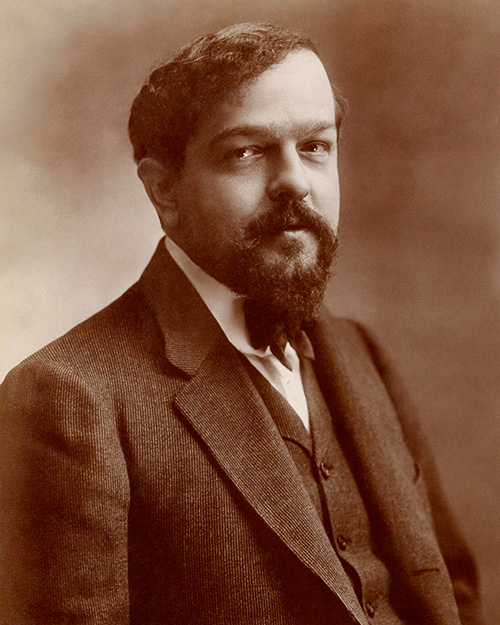
Image: Claude Debussy by Atelier Nadar (Adam Cuerden)
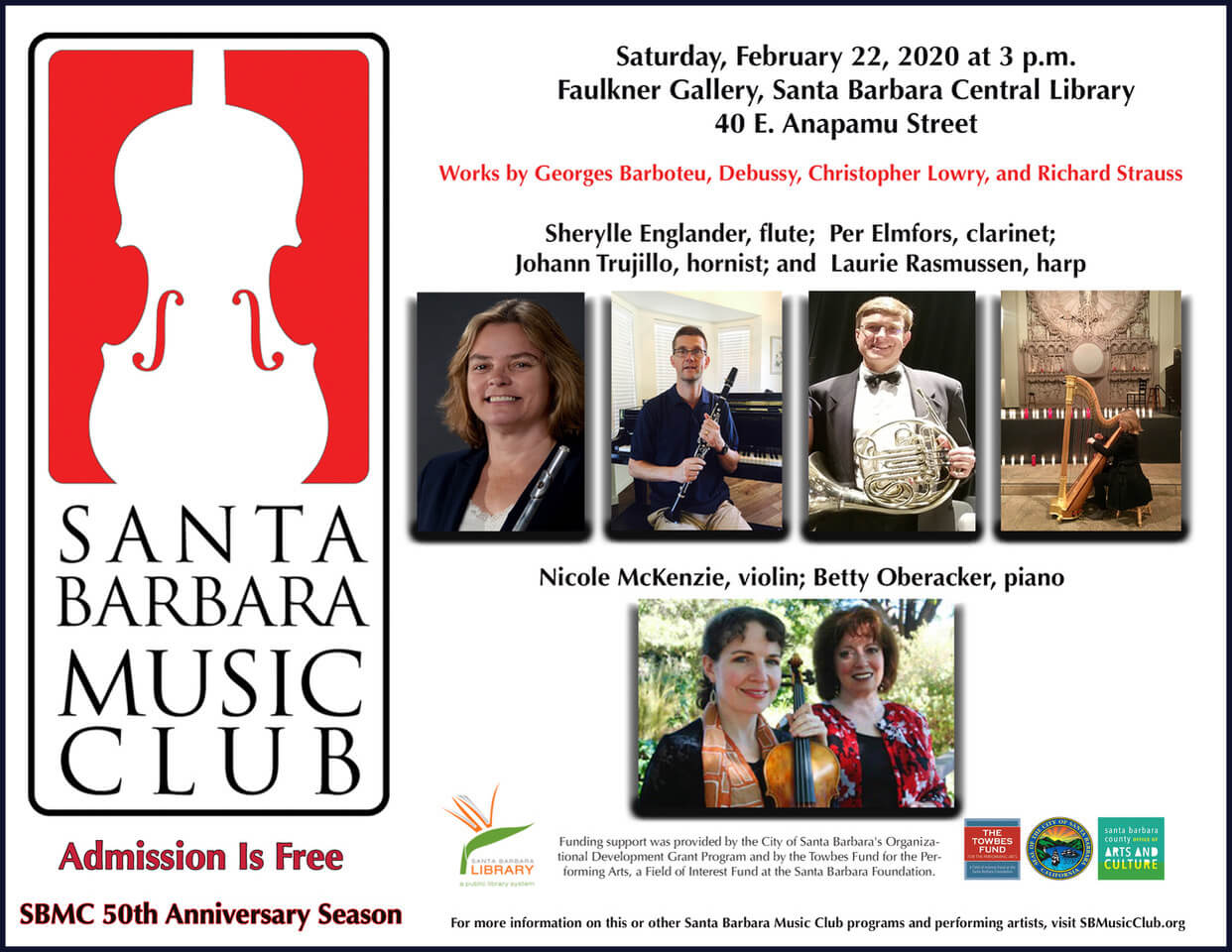
On Saturday, February 22 at 3 p.m. the Santa Barbara Music Club will present another program in its popular series of concerts of beautiful Classical music. The first portion of this afternoon’s program features an ensemble cast of performers: flutist Sherylle Englander, clarinetist Per Elmfors, horn player Johann Trujillo, and harpist Laurie Rasmussen. They will perform the well-known Prélude à l’après-midi d’un faune by Claude Debussy, Livewire! by American composer Christopher Lowry, and French composer and horn player Georges Barboteu’s Esquisse. The second portion of the program will be the Richard Strauss Sonata for Violin and Piano in Eb Major, Op. 18, performed by violinist Nicole McKenzie and pianist Betty Oberacker. This concert, co-sponsored by the Santa Barbara Public Library, will be held at the Faulkner Gallery of the library, 40 East Anapamu, Santa Barbara. Admission is free.
Program Details
(1924-2006)
Per Elmfors, clarinet
Johann Trujillo, horn
Laurie Rasmussen, harp
(1864-1949)
- Allegro, ma non troppo
- Improvisation: Andante cantabile
- Finale: Andante-Allegro
Betty Oberacker, piano
Notes on the Program
Commonly known as Prelude to the Afternoon of a Faun, the Prélude à l’après-midi d’un faune by Claude Debussy (1862–1918) is one of his most well-known works and has become a textbook example of Impressionism/Symbolism in Music Appreciation courses. The work, itself a tone poem, is a musical evocation of Stéphane Mallarmé’s poem “Afternoon of a Faun,” and then became the music for Vaslav Nijinsky’s ballet Afternoon of a Faun. The opening passage – one of the most famous in orchestral literature – immediately conveys the ethereal quality and harmonic ambiguity that would come to characterize much of Debussy’s music, to say nothing of his sense of tonal color. Although originally scored for three flutes, two oboes, cor anglais, two clarinets in A and Bb, two bassoons, four horns, two harps, two crotales and strings, Sherylle Englander, Per Elmfors, Johann Trujillo, and Laurie Rasmussen present an arrangement for single flute, clarinet, horn, and harp, respectively.
Englander, Elmfors, Trujillo and Rasmussen continue with two additional works, Livewire! by Nashville born composer Christopher Lowry (b. 1989) and Esquisse by French composer Georges Barboteu (1924–2006). The first piece, in the composer’s words, is a “short, energetic showpiece for flute, clarinet, and horn, which I composed over the summer of 2010 while spending time in Vienna, Austria, and Aix-en-Provence, France. The initial idea of the piece was inspired by “electrical issues” [I] experienced while overseas, beginning with my excursion to London earlier in the year. Basically, I have “shorted-out” or otherwise destroyed several appliances (including a hairdryer, a power strip, and several power adapters and voltage converters) due to both faulty equipment and ignorance. Regardless of the adapters I use or the voltage I set things to, I always seem to end up destroying something. Though this is extremely irritating, it “sparked” inspiration (pun completely intended) for this piece.”
By contrast, Barboteu’s Esquisse for flute, horn, and harp aligns more closely with the soundscape of Debussy’s music, as it strikes one as subtle and emerging. Although the flute and harp play integral roles in this work, the composer’s life as a horn player shines through the musical fabric, as he developed new performance techniques for the instrument. If you listen carefully enough, perhaps you’ll hear slight twinges and passing suggestions of American jazz, as Barboteu had a working relationship with Duke Ellington.
Before making his lasting mark on the musical world with operas as Salome and Elektra or tone-poems like Also sprach Zarathustra and Don Quixote, pre-eminent early modernist of German music Richard Strauss (1864–1949) began his musical life as a disciple of Johannes Brahms. He therefore championed genres of the so-called “Absolute Music” school, as evidenced by the Sonata for Violin and Piano in Eb Major, Op. 18. Composed between 1887 and 1888, Strauss fits this large work into traditional formal structures championed by Brahms and reaching back to the Classical Viennese composers of the late eighteenth century. Although traditional in form, this early work shows the melodic inventiveness so characteristic of Strauss’s later, operatic works. Violinist Nicole McKenzie and pianist Betty Oberacker conclude this afternoon’s program with this sweeping chamber work.
The Performers
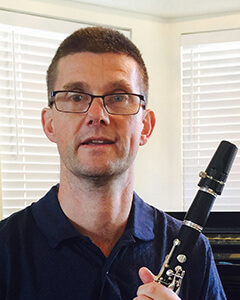
Per Elmfors, clarinetist, was born in Sweden and earned his PhD in Physics from Chalmers Institute of Technology (Gothenburg, Sweden). An avid chamber musician, his emphasis has been on performing with string and woodwind ensembles. He is currently Principle Clarinet in the SBCC Symphony, and also plays in several chamber music ensembles. Dr. Elmfors moved to Santa Barbara in 2010, and is a Senior Systems Engineer at FLIR Systems.
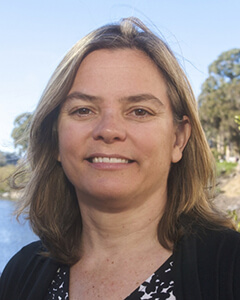
Sherylle Mills Englander, flutist, grew up in the Los Angeles area, where she studied flute with Louise DiTullio. She holds a BM Degree from the Eastman School of Music and pursued graduate studies at the San Francisco Conservatory of Music in Timothy Day’s studio. Ms. Englander is currently a member of the SBCC Concert Band and the SB Community Flute Ensemble, and performs in a variety of local concerts. Recognized by the Pacific Coast Business Times as one of 2016’s “Top 50 Women in Business,” Ms. Englander manages UCSB’s intellectual property portfolio as Director of its Office of Technology & Industry Alliances: she credits her musical background for her ability to think outside the box in the tech and research environment.

Nicole McKenzie, violinist, has performed widely as soloist and chamber musician. The Santa Barbara Independent declared, “McKenzie made a splash… she performed with gorgeous musicality.” Winner of the Sutton Chamber Music Award, she graduated from Interlochen Arts Academy, earned a BM degree from Oberlin Conservatory, an MM degree from Florida State University, and studied with Gary Kosloski at the Music Academy of the West. She has studied improvisation with Christian Howes. Ms. McKenzie is concertmaster of the Santa Barbara Folk Orchestra, and performs in the accordion/violin duo Continental Cafe. She played electric violin in M.O.B. Jazz Ensemble, and regularly concertized with renowned pianist, Betty Oberacker. She has taught music to students of all ages, and is currently the elementary music teacher for the Carpinteria School District. She has worked at UC Santa Barbara as a lecturer and as a music director and music performer in the Theater and Dance Department. She has created a collaborative dance and music improvisation group and has performed in various music styles including classical, jazz, folk, klezmer, and musical theater. She performs on a violin created for her by Michel Eggimann of Rome, Italy.
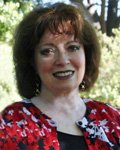
Betty Oberacker, pianist, is internationally acclaimed for her interpretations of both traditional and contemporary solo and chamber music repertoire, and has toured throughout Europe, Israel, Asia, Australia, New Zealand, Mexico and the U.S., including performances at Carnegie Hall, Amsterdam Concertgebouw, Berlin Philharmonic Hall and Vienna Musikverein. She has been Artist-in-Residence at 55 universities, conservatories and music festivals worldwide, and many important composers have dedicated their compositions to her. Her musical gifts were evidenced at three, when she began to play the piano and compose entirely by ear. Piano lessons started at age seven, and at nine she was accepted on scholarship as the only child student of the noted pianist Beryl Rubinstein. Her BM/MM Degrees are from the Cleveland Institute of Music, and her DMA Degree is from Ohio State University, where she was concomitantly a member of the piano faculty. Her discography includes Bach’s Well-Tempered Clavier (Clavier Records), A Bach Commemorative Recital (MIT Great Performances Archives), Chamber Music of Emma Lou Diemer (Orion), Schönberg’s Pierrot Lunaire (Century), John Biggs’ Variations on a Theme of Shostakovich (VMM), and Diemer’s Piano Concerto (MMC), the latter two works composed for Oberacker. Honors accorded her include a Fulbright Research Fellowship to Italy and the University of California Distinguished Teaching Award, and her students hold important positions as performers and teachers in the U.S., Asia and Europe. Dr. Oberacker is UCSB Professor Emeritus, and enjoys an active performing, teaching and chamber music coaching schedule.
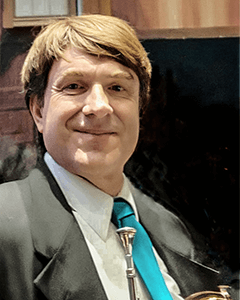
Johann Trujillo is a French horn player based in Santa Barbara, performing regularly with local ensembles such as the Santa Barbara Chamber Players, the Santa Barbara City College Symphony and Concert Band, the Ojai Pops Orchestra, and the Bottom-Line Brass. He is also a co-founder of the Los Padres Sound, a horn quartet that performs throughout the region from Goleta to Ojai. Johann studied horn at UC Davis while pursuing a Ph.D. in Electrical Engineering, balancing his love for music with his professional career.

Laurie Rasmussen, harpist, has toured across the U.S., Canada, and Europe as soloist and collaborative artist. She graduated from the University of Colorado at Boulder, was top prize winner at the 2007 Lyon & Healy International Jazz and Pop Harpfest Competition, and was featured artist at Celtic music festivals in Germany and Italy. Laurie is currently harpist with the SB Folk Orchestra, is Instructor at SB City College, maintains a private teaching studio, and is owner of the harp showroom, Harps by the Sea.
This concert is presented in partnership with the Santa Barbara Public Library. Funding support for our 50th Anniversary Season is provided by the City of Santa Barbara's Organizational Development Grant Program and by the Towbes Fund for the Performing Arts, a field of interest fund of the Santa Barbara Foundation.