

On Saturday, March 21 at 3 p.m., the Santa Barbara Music Club will present another program in its popular series of concerts of beautiful Classical music. Soprano Carolyn Kimball Holmquist, flutist Kirsten Becker, and pianist Eric Valinsky will feature vocal works by J.S. Bach, Franz Schubert, Frank Martin, George Gershwin, and Claude Bolling. Marian Drandell Gilbert concludes the program with solo piano music by Claude Debussy, Franz Liszt, and Sergei Prokofiev. This concert, co-sponsored by the Santa Barbara Public Library, will be held at the Faulkner Gallery of the library, 40 East Anapamu, Santa Barbara. Admission is free.
This concert was cancelled due to the COVID-19 shutdown.
Program Details
Had the concert not been cancelled, this would have been the program:
(1898-1937)
Kirsten Becker, flute
Eric Valinsky, Piano
(1891-1953)
Notes on the Program
Soprano Carolyn Kimball Holmquist, flutist Kirsten Becker, and pianist Eric Valinsky open the program with a star-studded compilation of well-known, adored works. The first two pieces enjoy most notoriety within church services, weddings, and Marian devotions: Sheep May Safely Graze by J.S. Bach (1685–1750) and Franz Schubert’s (1797–1828) lied Ave Maria. Next, the set Trois chants de noel comprises three Christmas songs by the twentieth-century Swiss composer Frank Martin (1890–1974). Although not as well known as other works on the program, the songs feature Martin’s late, mature style, which combines the sensual melodic lines of French Impressionism and twelve-tone techniques like that of Schoenberg. Next comes three selections by George Gershwin (1898–1937)—“S Wonderful,” “Fascinatin’ Rhythm,” and “I Got Rhythm.” Each song originally comes from a Broadway musical: Funny Face (1927), Lady Be Good (1927), and Girl Crazy (1930), respectively. Eric Valinsky and Becker complete their set with an excerpt from French pianist and composer Claude Bolling’s (b. 1930) Suite for Flute and Jazz Piano. The suite originally comprises seven short movements, which fuses classical techniques and styles, as demonstrated in the flute part, and a jazz sonorities and rhythms for the piano. Each performer runs the stylistic gamut, ranging from Baroque to Jazz in this eclectic selection of pieces.
French composers have a long tradition of writing fiery toccatas in the keyboard tradition. Translated roughly to “touch piece” and originating in the late sixteenth century, the toccata became a free flight of fancy: a vehicle for performers to showcase their technical prowess. The Symbolists and Impressionists of fin-de-siècle France continued this tradition and composed extremely demanding and opulent works. Claude Debussy (1862–1918) included a toccata as the third and final piece of his 1903 Estampes (Prints), titled “Jardins sous la pluie” (“Gardens in the Rain”). Debussy wrote relentless, rapid passages – typical of toccatas – to suggest a rainstorm, from which emerges excerpts of two French folk songs, Nous n’irons plus aux bois (“We Will Not Return to the Woods”) and Dodo, l’enfant do (“Sleep, Child, Sleep”). Marian Drandell Gilbert thus begins the second half of the program with an inundation of sonority and movement.
She continues with another work incorporating virtually perpetual motion that has an altogether different mood, the famous “Un Sospiro” (“A Sigh”) from the Trois études de concert, S.144, by Franz Liszt (1811–1888). Liszt composed these three studies between 1845–1849, and each takes a different character while requiring different technical capabilities. For this piece, performers must divide a beautiful pentatonic melody between the hands, which requires several hand crossings. Although the pianist’s hands leap across the keyboard and suggest pyrotechnic abilities, the result is an ironically calm and peaceful musical utterance. Due in part to the sweeping melody and accompaniment, Un Suspiro has become the most popular among the three etudes and among the most beloved of Liszt’s compositions.
Gilbert completes her program with the short but fiendishly challenging Piano Sonata No. 3 in A Minor, Op. 28 by Sergei Prokofiev (1891–1953). The composer wrote this single-movement sonata in 1917, which traces to ideas he began sketching in a notebook as a teenager. In signature Prokofiev style, the piece opens with an aggressive attack of chords and a jagged melody that encompasses a wide range on the keyboard. The sonata, however, requires expressive control as its mood, tempo, and character change frequently and suddenly. Also true to Prokofiev’s style, the work never fails to thrill.
The Performers

Carolyn Kimball Holmquist, soprano, graduated from Mt. Holyoke College and has won international acclaim for her concert, film, musical comedy, opera, theatrical, and TV appearances. She has represented the U.S. in the Tchaikovsky International Vocal Competition, toured Central and South America presenting American music for the U.S. State Department, and sang three seasons with the Bellas Artes National Opera. Ms. Holmquist sings in six languages, and has had leading roles in many musicals, including Carousel and The Sound of Music. In addition to numerous TV appearances, she starred in a Gershwin tribute for ABC and had a recurring role on the PBS Series, On Common Ground.
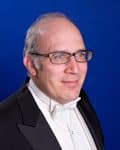
A native Manhattanite, Eric Valinsky has, for more years than he would like to admit, maintained dual careers in computer systems architecture and music. He was educated at the Oberlin Conservatory of Music and the University of Illinois, finally achieving his DMA in music composition from Columbia University. He studied composition with Walter Aschaffenburg, Salvatore Martirano, Jack Beeson, and Darius Milhaud; piano with Sara Crawford Drogheo and Emil Danenberg; and conducting with Harold Farberman. While living in Los Angeles, he became music director and composer-in-residence for The Storie-Crawford Dance Theatre Ensemble. Returning to New York, he served in a similar capacity for Danny Buraczeski’s Jazzdance, Uris Bahr and Dancers, and The New American Ballet Ensemble as well as composer-in-residence for The Rachel Harms Dance Company, Opera Uptown, and the Dance Department at City College of New York. He is currently Music Director for the American Dance & Music Performance Group and moonlights as founder and partner of Inlineos LLC, a strategic Internet consulting company.
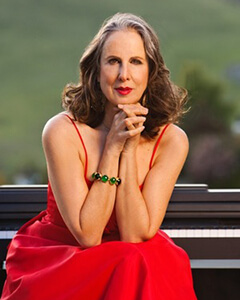
Marian Drandell Gilbert, pianist, received her BM degree from UCSB and her Masters in piano performance from the Manhattan School of Music. She has twice attended the Music Academy of the West. She maintains a private teaching studio in San Luis Obispo, where she lives with her husband and two children. She is a soloist with the San Luis Chamber Orchestra and is on the Board of Directors of the SLO Symphony Orchestra.
This concert is presented in partnership with the Santa Barbara Public Library. Funding support for our 50th Anniversary Season is provided by the City of Santa Barbara's Organizational Development Grant Program and by the Towbes Fund for the Performing Arts, a field of interest fund of the Santa Barbara Foundation.