

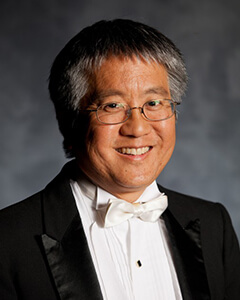
Image: Shinji Eshima by Scott Wallace Johnston
On SATURDAY, MARCH 5 at 3 p.m. the SANTA BARBARA MUSIC CLUB will present another program in its popular series of concerts of beautiful Classical music at Faulkner Gallery in the downtown Public Library.
The program opens with Edward Elgar’s lyrically reflective Romance for Bassoon and Strings, Op. 62, performed by Paul Mori and a string quartet composed of Isaac Kay and Andrea Lárez, violins, Erik Fauss, viola, and Wynston Hamann, cello. The same performers will then present Krapp’s Endgame (2009) by the American composer Shinji Eshima. Violinist Nicole Mckenzie and pianist Betty Oberacker will conclude the program with the mighty “Kreutzer” Sonata, No. 9 in A major, Op. 47 of Ludwig van Beethoven.
Program Details
(b. 1958)
Isaac Kay, Andrea Lárez, violins
Erik Fauss, viola; Wynston Hamann, cello
(1770-1827)
- Adagio sostenuto-Presto
- Andante con variazioni
- Finale: Presto
Betty Oberacker, piano
Notes on the Program
by Betty Oberacker
One of the highlights of Santa Barbara Music Club’s concerts is the opportunity for audiences to hear great music from a variety of historical periods, with a diversity of musical forms, performed by excellent artists.
The program opens with Edward Elgar’s lyrically reflective Romance for Bassoon and Strings, Op. 62, performed by Paul Mori and a string quartet composed of Isaac Kay and Andrea Lárez, violins, Erik Fauss, viola, and Wynston Hamann, cello. Originally for orchestra, this version by Trevor Cramer retains the gentle and beautifully flowing sonorities and tonal colors of the original, while basking in the intimacy and clarity of the chamber music format.
The same performers will then present Krapp’s Endgame (2009) by the American composer Shinji Eshima. Based on a play by Samuel Beckett, the work is scored for bassoon, string quartet, and optional Buddhist monk. In Beckett’s play, a man is reviewing his life through recordings he has made of himself on each of his birthdays; Eshima’s score emphasizes the ensuing emotional turmoil, commencing with an opening statement marked “Crying despair” and subsequently including some chanting from the quartet.
Violinist Nicole Mckenzie and pianist Betty Oberacker will conclude the program with the mighty “Kreutzer” Sonata, No. 9 in A major, Op. 47 of Ludwig van Beethoven. Composed in 1803, the work was noted in the composer’s sketchbook as “Sonata per il Pianoforte ed uno violino obligato in uno stile molto concertante come d’un concerto” (Sonata for Piano and Violin Obligato in a Very Concertante Style, Like a Concerto). The sonata takes its nickname from the famed 18th-century virtuoso violinist Rodolphe Kreutzer (composer of the infamous violin exercise made famous by Jack Benny), but it was not actually premiered or even performed by Kreutzer; instead, Beethoven enlisted the violinist George Bridgetower to collaborate with him in the first performance.
The history of that premiere is fascinating: shortly after the work’s completion it was presented at a concert that started at the unusually early hour of 8 am. Bridgetower sight-read the piece, as he had never seen the work before, and there had been no time for any rehearsal. Though the premiere was by all accounts a success, the spirited collaboration of Beethoven and Bridgetower was short lived, as after the performance, while the two were drinking, Bridgetower apparently insulted the morals of a woman whom Beethoven cherished. Enraged, he changed the title page, dedicating the work to Kreutzer, who was considered the finest violinist of the day. (Yet it should be noted that Kreutzer considered the sonata “outrageously unintelligible” — nor did he care for any of Beethoven’s music!)
The sonata’s three-movement structure encompasses unsurpassed brilliance and emotional scope: the brief but profound Adagio sostenuto introduction quickly erupts into a Presto of enormously propulsive excitement; the dignified romanticism that permeates the theme of the Andante con variazioni lends its beauty to inspire the ensuing five variations, with the final one expanding into delicate and scintillating philosophical realms. Then, a bold chord breaks the spell and the final movement, Presto, is off and running, its unflagging exuberance providing a thrillingly virtuosic conclusion to this momentous musical edifice.
The Performers
Paul Mori, bassoon, received his earliest start in music through school music programs here in his native Santa Barbara and continued his musical education at Westmont College. From here, he relocated to Baltimore to study at the Peabody Institute of Johns Hopkins University, earning a master’s degree in bassoon performance with Phillip Kolker and later completing a doctorate in orchestral conducting, studying with the legendary Frederik Prausnitz. He served as music director of orchestras in the Pacific Northwest and Baltimore before returning to Santa Barbara. Currently, he conducts the Santa Barbara Reading Orchestra and is on the music faculty at Westmont College.
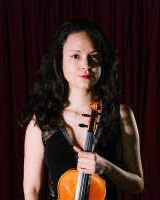
Andrea Lárez, violinist, graduated from Westmont College in 2017. She is currently a member of the Camerata Internacional de Barcelona.
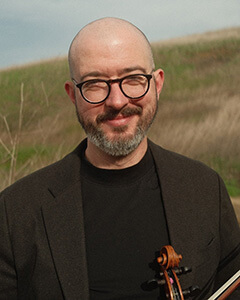
Isaac Kay, violinist, is a senior at Westmont College, majoring in Music Performance and studying with Dr. Han Soo Kim. He studied at the Cleveland Institute of Music during his high school years, and was a principle player in the Cleveland Orchestra Youth Orchestra. Isaac has performed in the Brevard and Credo Chamber Music Festivals and the Stringendo School for Strings.
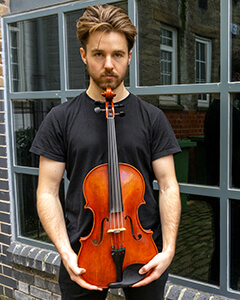
Erik Fauss is a freelance violist and singer/songwriter. He is currently finishing his Masters at the Royal Academy of Music, studying with Juan-Miguel Hernandez and Helene Clement. Before moving to London, Fauss completed his Bachelor of Arts magna cum laude at Westmont College in Santa Barbara, California. In the Fall of 2016, he studied with Matthias Maurer and Thomas Selditz in Vienna and Yuta Nishiyama at the University of Arts in Berlin.

Wynston Hamann, cellist, is a freshman at Westmont College, studying with Trevor Handy and performing in the Westmont College Orchestra and chamber music groups. Wynston has been a pupil of Jamie Kellog in Phoenix, AZ, and spent four summers at Interlochen Summer for the Arts, studying with Jeffrey Lestrapes and performing with the World Youth Symphony Orchestra.

Nicole McKenzie, violinist, has performed widely as soloist and chamber musician. The Santa Barbara Independent declared, “McKenzie made a splash… she performed with gorgeous musicality.” Winner of the Sutton Chamber Music Award, she graduated from Interlochen Arts Academy, earned a BM degree from Oberlin Conservatory, an MM degree from Florida State University, and studied with Gary Kosloski at the Music Academy of the West. She has studied improvisation with Christian Howes. Ms. McKenzie is concertmaster of the Santa Barbara Folk Orchestra, and performs in the accordion/violin duo Continental Cafe. She played electric violin in M.O.B. Jazz Ensemble, and regularly concertized with renowned pianist, Betty Oberacker. She has taught music to students of all ages, and is currently the elementary music teacher for the Carpinteria School District. She has worked at UC Santa Barbara as a lecturer and as a music director and music performer in the Theater and Dance Department. She has created a collaborative dance and music improvisation group and has performed in various music styles including classical, jazz, folk, klezmer, and musical theater. She performs on a violin created for her by Michel Eggimann of Rome, Italy.
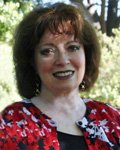
Betty Oberacker, pianist, is internationally acclaimed for her interpretations of both traditional and contemporary solo and chamber music repertoire, and has toured throughout Europe, Israel, Asia, Australia, New Zealand, Mexico and the U.S., including performances at Carnegie Hall, Amsterdam Concertgebouw, Berlin Philharmonic Hall and Vienna Musikverein. She has been Artist-in-Residence at 55 universities, conservatories and music festivals worldwide, and many important composers have dedicated their compositions to her. Her musical gifts were evidenced at three, when she began to play the piano and compose entirely by ear. Piano lessons started at age seven, and at nine she was accepted on scholarship as the only child student of the noted pianist Beryl Rubinstein. Her BM/MM Degrees are from the Cleveland Institute of Music, and her DMA Degree is from Ohio State University, where she was concomitantly a member of the piano faculty. Her discography includes Bach’s Well-Tempered Clavier (Clavier Records), A Bach Commemorative Recital (MIT Great Performances Archives), Chamber Music of Emma Lou Diemer (Orion), Schönberg’s Pierrot Lunaire (Century), John Biggs’ Variations on a Theme of Shostakovich (VMM), and Diemer’s Piano Concerto (MMC), the latter two works composed for Oberacker. Honors accorded her include a Fulbright Research Fellowship to Italy and the University of California Distinguished Teaching Award, and her students hold important positions as performers and teachers in the U.S., Asia and Europe. Dr. Oberacker is UCSB Professor Emeritus, and enjoys an active performing, teaching and chamber music coaching schedule.