

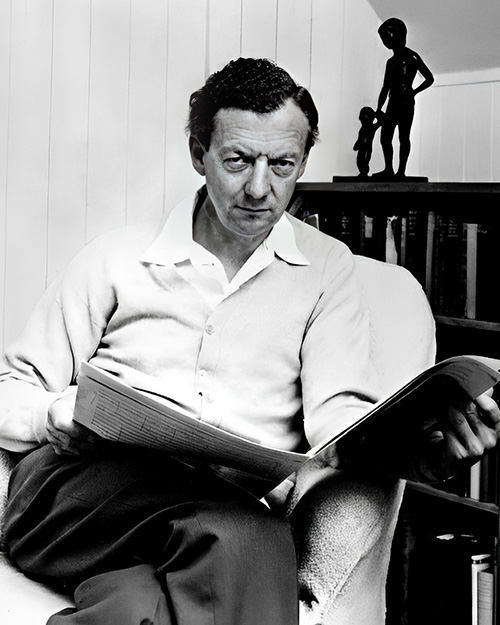
Image: Benjamin Britten by Hans Wild for High Fidelity magazine | Public Domain
On Saturday, October 22 at 3 PM, the Santa Barbara Music Club presents a free concert at the Faulkner Gallery in the Downtown Santa Barbara Public Library. Pianist Mao Saito will perform Alexander Scriabin’s Piano Sonata No. 3 in F-sharp minor, Op. 23. Oboist Adelle Rodkey will play selections from Benjamin Britten’s Six Metamorphoses after Ovid, Op. 49 and the Telemann Fantasia in e minor, written originally for unaccompanied flute. In a set entitled “What About the Waltz?”, soprano Deborah Bertling and pianist Kacey Link will perform “Je veux vivre” by Charles Gounod, from the opera Romeo et Juliette and “Heut’ macht die Welt Sonntag für mich” by Johann Strauss II. They will be joined by baritone Brian Hotchkin for a performance of the Merry Widow Valse by Franz Lehár.
Program Details
(1681-1767)
- Largo
- Spirituoso
- Allegro
(1870-1948)
Kacey Link, piano
Brian Hotchkin, baritone
(1913-1976)
- Pan
- Niobe
- Phaeton
(1872-1915)
- Drammàtico
- Allegretto
- Andante
- Presto con fuoco
Notes on the Program
The Piano Sonata No. 3 in F-sharp minor, Op. 23, by Alexander Scriabin, was composed between 1897 and 1898 in Paris. The sonata consists of four movements and is said to describe the “states of the soul,” from a “whirlpool of suffering strife” in the first movement to the tenderness of the third.
Benjamin Britten’s Six Metamorphoses after Ovid, Op. 49 were written in 1951 and premiered by Joy Boughton at the Aldeburgh Festival that same year. Each of the movements is a musical response to a character in the literary work, and as such, there is a great deal of contrast between them. Ms. Rodkey will perform three of the movements, “Pan,” “Niobe,” and “Phaeton.” The full titles of the movements give insight into the character of the music in each:
- PAN who played upon the reed pipe which was Syrinx, his beloved.
- PHAETON who rode upon the chariot of the sun for one day and was hurled into the river Padus by a thunderbolt.
- NIOBE who, lamenting the death of her fourteen children, was turned into stone.
Georg Philipp Telemann lived from 1681-1767. His 12 Fantasias for Solo Flute, TWV 40:2–13, were published in Hamburg in 1732–33. Number 8, in e minor, has three movements, (Largo—Spirituoso—Allegro).
In Charles Gounod’s opera, Romeo et Juliette, “Je veux vivre” (“I want to live”) is sung by Juliette early in the opera, before she meets and falls in love with Romeo. When others speak of marriage to her, she sings that she would like to live inside her dream, where it is eternally spring, rejoicing in her youth and innocence.
The theme for “Heut’ macht die Welt Sonntag für mich” (“Today the whole world is like Sunday to me”) was written by Johann Strauss II (1825-1899). The piece as we’ll hear it is from a film entitled “Kaiserwalzer” (“The Emperor’s Waltz”), a German language musical comedy directed by Frederic Zelnik and released in Germany in 1933. The lyric was written by Alfred Grunwald and Robert Blum and it was arranged by Nico Dostal. A recording from 1934 features Dostal’s wife, Marta Eggerth (1912-2013), who played a leading role in the film.
Franz Lehár’s most famous work is undoubtedly Die lustige Witwe (The Merry Widow). Premiered in Vienna in 1905, the operetta was a worldwide hit. In addition to many revivals, some in translation, it has been adapted for film and for dance. The “Merry Widow Waltz” is a tender duet between Hanna Glawari—the “merry widow”—and her suitor, Count Danilo Danilovitsch.
The Performers

Mao Saito was born in Osaka, Japan in 1986. She graduated as the best student from Kyoto City University of Arts in 2009. From 2010 to 2012, she studied at Hochschule für Musik Hanns Eisler in Berlin with Prof. Fabio Bidini, attaining a Master of Music with the best note in 2012. Mao Ishida won the “Ugorski Special Prize for an outstanding performance of Schumann” at the ARD International Piano Competition in Germany in 2011, the third prize at the 8th piano competition Prix Amadèo in Aachen in 2012, and the second prize at the 6th Berlin piano competition in 2012. She was on a scholarship from Yamaha Music Foundation from 2012-2015, and got “Final round scholarship” at the 60th Busoni International Piano Competition in 2015. She often performs chamber music in Japan and Berlin and works as an accompanist.
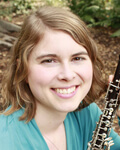
Adelle Rodkey, oboist, received her BM Degree in Music Pedagogy, magna cum laude, from Wheaton Conservatory of Music (Illinois), where she studied oboe with Carl Sonik. A native of Santa Barbara, she was an oboe student of Anne Anderson and a piano student of Lana Bodnar and Marilyn Clemons. Honors accorded her have included the President’s Award from Wheaton College, as well as awards from the Music Teachers National Association and the Pillsbury Foundation. Adelle performs frequently in several orchestras and chamber music ensembles, and is Instructor of Oboe at Westmont College. As a member of the Suzuki Association of the Americas, she maintains a private studio of oboe and piano students.

Deborah Bertling (Soprano) earned her Bachelor of Arts degree at Bob Jones University, Greenville, SC. She also earned a certificate at American Academy of Dramatic Arts in Los Angeles. She has performed in dozens of operas, plays, and concerts throughout California, most recently in Gianni Schicchi and Suor Angelica with Opera Santa Barbara. She is President of Performing Arts Scholarship Foundation, 1st Vice President of Community Arts Music Association, music docent in local elementary schools and mentor with Royal Family Kids. She will appear in the world premiere full-length feature film, Mirror Of My Soul, March of 2017. www.deborahmarksbertling.com

Brian Hotchkin is a baritone, vocal instructor, and stage director. Hailed for his “strong and effortless” voice and his “unerring, witty sense of theater,” Brian has performed opera, music theater and cabaret performances with companies that include the Virginia Opera, Opera New Jersey, Opera Santa Barbara, Chamber Opera Chicago, and the Aspen Music Festival. His many operatic roles include Papageno in The Magic Flute, both Marcello and Schaunard in La bohème, and the title role in The Marriage of Figaro. Equally at home in operetta and musical theater, Brian has performed leading roles including KoKo in The Mikado, Bobby in Sondheim’s Company and Merlyn/Pellinore in Camelot. As a stage director, Brian has led recent productions of Adam Guettel’s The Light in the Piazza and Sweeney Todd for Ventura College. Brian served as Company Manager and Artistic Administrator for Opera Santa Barbara, and currently teaches singing to students of all ages at his private voice studio in Santa Barbara.
This project is funded in part by the Community Arts Grant Program using funds provided by the City of Santa Barbara in partnership with the Santa Barbara County Arts Commission.