

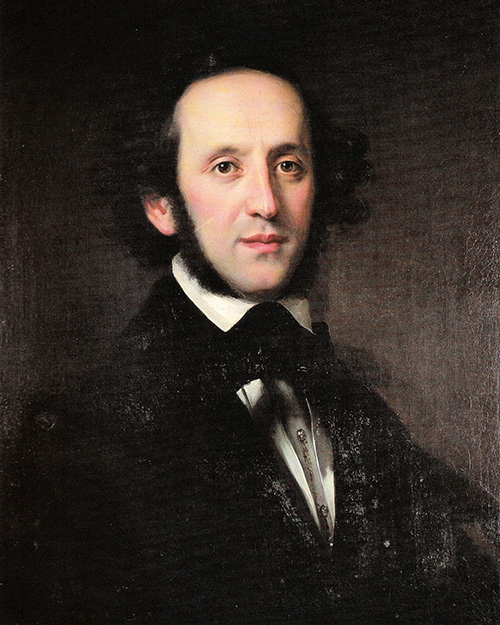
Image: Felix Mendelssohn by Eduard Magnus - Berlin State Library, Public Domain
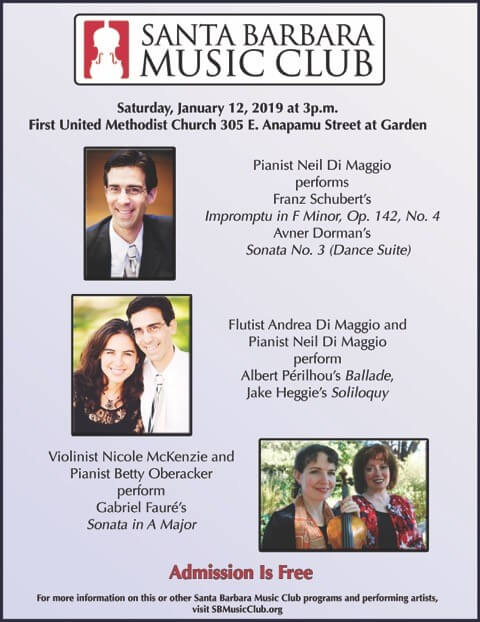
On Saturday, January 12 at 3 p.m. the Santa Barbara Music Club will present another program in its popular series of concerts of beautiful Classical music. On this afternoon’s program, piano and flute duo Andrea and Neil Di Maggio and violin and piano duo Nicole McKenzie and Betty Oberacker feature works described as “elegant outliers.” These pieces don’t quite fit the mold in terms of historical setting, genre, style, and so forth; yet they captivate us nonetheless. The afternoon’s performance includes two pieces for flute and piano: Albert Périlhou’s Ballade and Jake Heggie’s Soliloquy; two works for solo piano: Franz Schubert’s Impromptu in F Minor (Op. 142/4) and Avner Dorman’s Sonata No. 3 “Dance Suite.” The final work is Gabriel Fauré’s Sonata for Violin and Piano in A Major, Op 13. This concert will be held at First United Methodist Church, 305 East Anapamu (at Garden), Santa Barbara. Admission is free.
NOTE: The Fauré Sonata was substituted with a performance of Mendelssohn’s original version of Midsummer Night’s Dream for piano four hands, played by Betty Oberacker and Eric Valinsky.
Program Details
(1797-1828)
(b. 1961)
Neil Di Maggio, piano
(b. 1975)
- Prelude
- Oud and Kanun
- Techno
(The composer’s original version)
(1809-1847)
- Overture
- Nocturne
- March of the Elves
- Wedding March
Notes on the Program
When we think of French composers of the fin de siècle, we tend to think of the bigger, rule-breaking names: Debussy, Ravel, and Satie. Or we may think of the last bastions of tradition: Fauré, Saint-Saëns, and Franck. How often do we think of Classicists at heart? Composer Albert Périlhou (1846 – 1936) fits such a bill, as his musical tastes stand virtually in opposition to the French musical establishment of his day. Yet his pedigree suggests otherwise. Périlhou entered the École Niedermeyer in 1855 and studied for ten years, eventually becoming student of Saint-Saëns and affiliated with Eugene Gigout. He also was classmates with Fauré and André Messager. In 1891, Périlhou became organist at the prestigious Saint-Séverin in 1891, which made him colleagues with towering French figures including Charles Marie Widor and Louis Vierne. Périlhou certainly was part of the “who’s who” of French composers, having been exposed to an intensely Romantic string of compositional styles. Nonetheless, Périlhou’s good friend Vierne called him a “composer of the 18th century” so impressed was he by Perilhou’s almost flawless clarity of form. Indeed, Périlhou’s music seems to transcend the mercurial flux that all too often characterized music of the fin de siècle; rather, he strove for consistency of balance, elegance, and refinement. Although Périlhou’s music lies on the periphery of contemporaneous French style, it effectively counterbalances that of his ultra-Romantic and even early-Modernist colleagues. Périlhou’s catalogue largely includes works for piano, organ, orchestra, and voice. Therefore, his 1903 chamber piece Ballade in G Minor strikes as atypical, off the beaten track, yet no less gripping as Andrea and Neil Di Maggio respectively demonstrate on the flute and piano. Originally written for either solo flute or violin, the Ballade enjoyed prestige as a staple examination piece for the Paris Conservatoire. True to Périlhou’s style, the Ballade is virtuosic but not needlessly so, Romantic but reservedly so.
Andrea and Neil Di Maggio complete this duet of flute and piano chamber music with Jake Heggie’s (b. 1961) Soliloquy of 2012. This piece exists as Heggie’s arrangement of his art song “Beyond” from his Pieces of 9/11. Incidentally, the complete song cycle was commissioned and premiered by Santa Barbara’s own Camerata Pacifica as a memorial to Suzanne Makuch. Much like Périlhou’s Ballade, Heggie’s Soliloquy is a bit of an outlier within the context of the composer’s catalogue. Heggie writes most often for the voice: song cycles, choral works, and opera. In fact, Heggie’s prestige as a formidable American composer lies in his writing for opera. Moreover, the only other work in his catalogue for flute and piano is his 2009 Fury of Light. Because of his extensive work for the voice, it is no surprise his music possess a strong, intuitive lyricism. Living up to its name Soliloquy presents to listeners an intimate catharsis; the flute plays a repeating motif, akin to the rhetoric device of anaphora, while the piano gently accompanies.
Depending on one’s perspective, much of what Franz Schubert (1797 – 1828) wrote could be an outlier, so progressive was he in the genres he composed. Or everything could be typical of Schubert for precisely the same reason. Take his well-known, oft-performed impromptus – staples of the classical repertoire. The term “impromptu” denotes a free, improvisatory piece as if one were making it up on the spot. Schubert’s final collection of four impromptus, however, bears enough formal and thematic unity to resemble a cyclical work, perhaps even a four-movement sonata, although scholars often dispute this parallel. Regardless, the group betrays a cohesiveness and organization that problematizes the designation “impromptu.” Pianist Neil Di Maggio presents the last of the four, Schubert’s Impromptu No. 4 in F Minor, D. 935/Op. 142, bearing tonal and formal similarities as the first in the collection. In this final, technically demanding piece, Schubert explores remote key areas and treats several challenges such as rapid scales, thirds, leaps, quick dynamic contrasts, and so forth. It’s surprising one hasn’t mistaken the fourth impromptu for an étude!
Neil Di Maggio completes his performance this afternoon with Avner Dorman’s (b. 1975) Sonata No. 3 “Dance Suite” from 2005. The composer’s Israeli heritage informs the program of a piece where East meets West in dramatic ways. Dorman initially wanted to write a suite in the Western art tradition, as in a series of discrete, unrelated dance movements. To remedy the disconnect Dorman perceived, he decided to compose, in his words, a “dramatic piece, one that combines the vividness of dances with the emotional content of drama.” Thus the sonata takes us through a heavily textured, spatial journey of a blind Middle Eastern musician who plays the stringed oud. While the sonata is played typically as one continuous movement, the first movement represents the oud player’s symbolic wandering in darkness, relying only on his ears to navigate the emanating sounds of life. The second movement features sounds from the outside world forcing their way into the musician’s senses, in addition to the Arabic music he normally plays on the oud. The former are the sounds of the streets and modern-day techno and house music: quite the clash of sound worlds. The final movement shows the modern styles have almost taken over the traditional Arabic music. But not just yet, as stylistic gestures and rhythms of the former fuse with motifs of the latter. In essence, Dorman parallels a Hegelian triple of “thesis – antithesis – synthesis” in his treatment of Eastern and Western musical traditions. The result? A delicious bending of genre and style to the point that the work lies on the periphery of neat-and-tidy categorization.
And from the hustle and bustle of Arabic music and techno we return to France, to the music of Périlhou’s classmate, Gabriel Fauré (1845 – 1924). In hindsight, most classical-music enthusiasts regard Fauré as a traditional figure, especially in comparison to the so-called Impressionist composers who followed him. Yet examined against the backdrop of his French socio-historical contexts, Fauré himself is an outlier but also a trendsetter. Many elements of his life run against the grain of what French composers were like in the era immediately preceding the fin de siècle. He was not educated at the Conservatoire de Paris, and for many years his musical vision was considered too dangerous and revolutionary to be considered for a teaching post. Also his chamber works, among them the Sonata in A Major for Violin and Piano, Op. 13 (1875 – 76), were atypical of what French composers were producing in the 1870s. For all the apparent derision, Fauré eventually became director of the Conservatoire in the early 1900s, and his Violin Sonata, along with his Piano Quartet, Op. 15, and César Franck’s Violin Sonata in A Major became the premiere large-scale chamber works of the French Romantic tradition. Indeed, Fauré’s violin sonata received extravagant praise and became an instant classic of French chamber music. Violinist Nicole McKenzie and pianist Betty Oberacker offer this afternoon the last of today’s elegant outliers.
The Performers
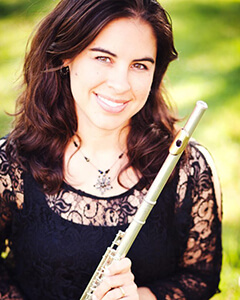
Andrea Di Maggio, Flutist, graduated from San Jose State University, summa cum laude, with a Bachelor of Music degree where she studied with Isabelle Chapuis. While attending Arizona State University, Andrea held a teaching position and worked with the undergraduate flute majors and music education students, and performed in faculty recitals. Studying with Jill Felber at the University of California, Santa Barbara, Andrea graduated with honors with a Masters Degree in Flute Performance. As flute instructor at Westmont College, she is a founding member of the woodwind quintet Sonos Montecito and a faculty member at the Westmont Academy of Young Artists. Andrea also maintains a small and competitive private flute studio, with students winning awards from the Santa Barbara Music Club, The Music Teachers Association of California, and the National Flute Association. Andrea performs on a Miyazawa flute.
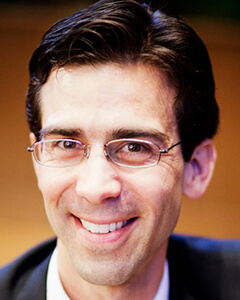
Neil Di Maggio, pianist, enjoys a dual career as solo and collaborative pianist and as a researcher for Westmont College. His performing career has taken him from California to Phoenix to New York City, and he recently served on the faculty of the Westmont Academy for Young Artists. He earned his BM Degree, summa cum laude, from San Jose State University, MM Degree from the San Francisco Conservatory, and MM Degree in Collaborative Piano from UCSB, studying with Paul Berkowitz Anne Epperson, and Yael Weiss. Currently Director of Research in the Office of College Advancement at Westmont, Neil maintains a private piano studio, and his students are frequent award winners with the Santa Barbara Music Club and the Performing Arts Scholarship Foundation competitions.

Betty Oberacker, pianist, is internationally acclaimed for her interpretations of both traditional and contemporary solo and chamber music repertoire, and has toured throughout Europe, Israel, Asia, Australia, New Zealand, Mexico and the U.S., including performances at Carnegie Hall, Amsterdam Concertgebouw, Berlin Philharmonic Hall and Vienna Musikverein. She has been Artist-in-Residence at 55 universities, conservatories and music festivals worldwide, and many important composers have dedicated their compositions to her. Her musical gifts were evidenced at three, when she began to play the piano and compose entirely by ear. Piano lessons started at age seven, and at nine she was accepted on scholarship as the only child student of the noted pianist Beryl Rubinstein. Her BM/MM Degrees are from the Cleveland Institute of Music, and her DMA Degree is from Ohio State University, where she was concomitantly a member of the piano faculty. Her discography includes Bach’s Well-Tempered Clavier (Clavier Records), A Bach Commemorative Recital (MIT Great Performances Archives), Chamber Music of Emma Lou Diemer (Orion), Schönberg’s Pierrot Lunaire (Century), John Biggs’ Variations on a Theme of Shostakovich (VMM), and Diemer’s Piano Concerto (MMC), the latter two works composed for Oberacker. Honors accorded her include a Fulbright Research Fellowship to Italy and the University of California Distinguished Teaching Award, and her students hold important positions as performers and teachers in the U.S., Asia and Europe. Dr. Oberacker is UCSB Professor Emeritus, and enjoys an active performing, teaching and chamber music coaching schedule.
A native Manhattanite, Eric Valinsky has, for more years than he would like to admit, maintained dual careers in computer systems architecture and music. He was educated at the Oberlin Conservatory of Music and the University of Illinois, finally achieving his DMA in music composition from Columbia University. He studied composition with Walter Aschaffenburg, Salvatore Martirano, Jack Beeson, and Darius Milhaud; piano with Sara Crawford Drogheo and Emil Danenberg; and conducting with Harold Farberman. While living in Los Angeles, he became music director and composer-in-residence for The Storie-Crawford Dance Theatre Ensemble. Returning to New York, he served in a similar capacity for Danny Buraczeski’s Jazzdance, Uris Bahr and Dancers, and The New American Ballet Ensemble as well as composer-in-residence for The Rachel Harms Dance Company, Opera Uptown, and the Dance Department at City College of New York. He is currently Music Director for the American Dance & Music Performance Group and moonlights as founder and partner of Inlineos LLC, a strategic Internet consulting company.