

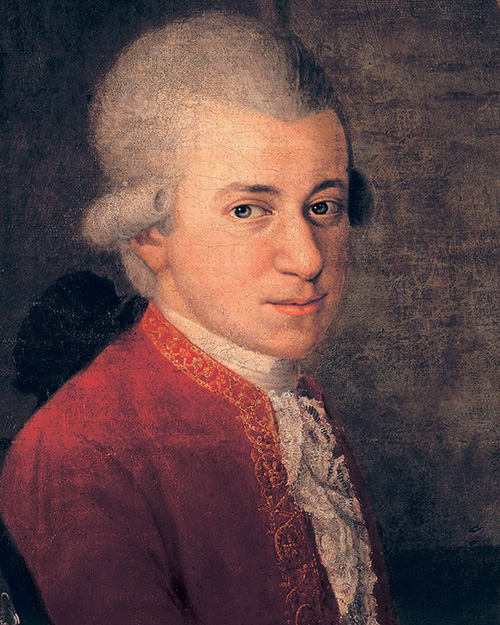
Image: Wolfgang Amadeus Mozart By Johann Nepomuk della Croce
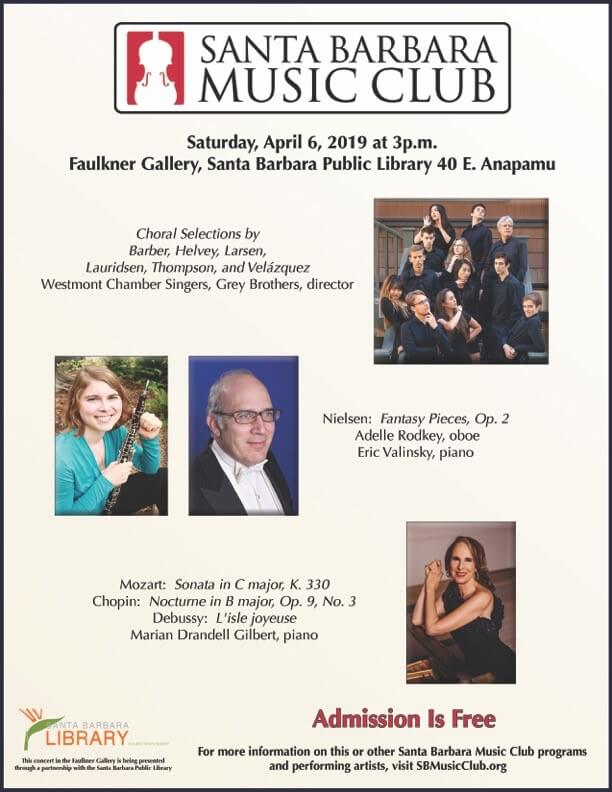
On Saturday, April 6 at 3 p.m. the Santa Barbara Music Club will present another program in its popular series of beautiful classical-music concerts. This afternoon, the Westmont Chamber Singers will perform the following works under director Grey Brothers: Felices ter by Randall Thompson; “Mary Hynes,” Reincarnations, by Samuel Barber; “Quando son più lontan,” Madrigali: Six “Fire Songs” on Italian Renaissance Poems, by Morten Lauridsen; “The Ol’ Chisholm Trail,” Western Songs, by Libby Larsen; and Bésame mucho by Consuelo Velázquez, arranged by Julio Morales. In addition, oboist Adelle Rodkey and pianist Eric Valinsky will perform Carl Nielsen’s Fantasy Pieces for Oboe and Piano (1889), and pianist Marian Drandell Gilbert concludes with a trio of works: Mozart’s Piano Sonata No. 10 in C Major, K 330; Chopin’s Nocturne in B Major, Op. 9/2; and Debussy’s L’isle joyeuse. This concert, co-sponsored by the Santa Barbara Public Library, will be held at the Faulkner Gallery of the library, 40 East Anapamu, Santa Barbara. Admission is free.
Program Details
(1916-2005)
(1865-1931)
- Romanze: Andante con duolo
- Humoresque: Allegretto scherzando
Eric Valinsky, piano
(1863-1918)
Notes on the Program
Compared to his American contemporaries, Randall Thompson (1899-1984) tends to have a more “traditional” harmonic palette and favored simple, easily digestible melodies. He worked tirelessly as a pedagogue to promote good choral singing, which resulted in almost single handedly revolutionizing male choirs in the USA. The Westmont Chamber Singers, under the direction of Grey Brothers, present one of the few choral pieces Thompson composed in a language other than English, “Felices ter” from the Six Odes of Horace. He drew from the poetry of the ancient Roman figure Horace himself and begins with one that translates to “Thrice Happy” and describes unbreakable bonds and love. The piece provides a good example of Thompson’s preference for traditional harmony. Upon first hearing, one might take this 1924 work for, say, a Palestrina or Gibbons motet. Reincarnations of Samuel Barber (1910-1981), however, provides a shift in harmonic gears. Like Thompson, Barber drew from poetry, in this case the Gaelic author Antoine O Reachtabhra (1784-1835). Barber’s source material was a collection of reconstructed (read resurrected) texts by the early twentieth-century novelist James Stephens. The Chamber Singers present the first of the three movements, “Mary Hynes,” which is a musical study on beholding a woman reputed for being the most beautiful in all Ireland.
Also drawing from past literary traditions, Morten Lauridsen (b. 1943) looked to the Italian Renaissance for his Madrigali: Six “Fire Songs” on Italian Renaissance Poems. The composer took inspiration from Gesualdo and Monteverdi, who predominantly used poetry when composing madrigals. Moreover, Lauridsen constructed harmony to suggest the images of fire for these pieces, a throwback to the madrigal tradition of “text painting.” The second movement “Quando son più lontan” features modal mixture, an example being a shift between B minor and B minor. The real drama comes, however, when single chords mix B major and B minor together. Also known as ‘simultaneous modal mixture’ in music theory, audiences can detect such harmony for its high degree of dissonance. The chord (or the listener!) virtually aches for resolution, like, as the text suggests, the wish to return to the gaze of a lover’s eyes. In stark contrast to fire and regret, Libby Larsen (b. 1950) paints an exuberant picture of the Wild West in “The Ol’ Chisolm Trail,” from the Western Songs. Larsen comingles narration with text-painting images, akin to Lauridsen. She excerpts the lengthy, seventeenth-century English ballad “The Old Chisolm Trail,” which became a cowboy song in the early 1900s. Larsen also includes sound effects to vivify the narrative, among them cowboy hollars and whistles. The Westmont Chamber Singers conclude with a Mexican love song, Bésame mucho by Consuelo Velázquez (1916-2005) and arranged by Julio Morales (b. 1987). Literally translated to “kiss me a lot,” the song made Velázquez famous with offers to work in Hollywood and with Walt Disney. The song also became an instant upon its release in 1941, as it describes the separation of lovers due to World War II. Although Bésame mucho is the only one on this program not drawn from poetry from the past, it is no less poetic in content. And while a theme of drawing from past poetry runs through most of the Westmont program, it seems they also paint images of love, as well.
While best known for his six symphonies, Danish composer Carl Nielsen (1865-1931) composed in virtually every genre. His earliest compositions show the influence of Romantic composers such as Brahms; later, his music evolved into a more acerbic, neoclassical idiom. Some twenty years after their premiere in 1889, Carl Nielsen wrote this about the the Fantasy Pieces for Oboe and Piano: “The two oboe pieces are a very early opus. The first—slow—piece gives the oboe the opportunity to sing out its notes quite as beautifully as this instrument can. The second is more humorous, roguish, with an undertone of Nordic nature and forest rustlings in the moonlight.” The Neilsen Fantasy Pieces will be performed by oboist Adelle Rodkey and pianist Eric Valinsky.
This afternoon concludes with a stylistic tour de force by Marian Drandell Gilbert, who interprets works from three composers spanning the eighteenth through twentieth centuries. Wolfgang Amadeus Mozart (1756-1791), Frédéric Chopin (1810-1839), and Claude Debussy (1862-1918) each have contributed among the most important works to the piano. Mozart’s Piano Sonata No. 10 in C Major, K. 330, remains one of his most popular and was published with two other ones, K. 331 and 332, in 1784. A potential reason for this sonata’s enduring popularity may be its range of character. The first movement suggests a nonchalant playfulness, while the third movement has a relentless energy that still manages to sound reserved.
Like Mozart’s sonata, Chopin’s Nocturne in B Major, Op. 9/3, also comes from a collection of three. The Op. 9 nocturnes (1830-1833) are possibly the most well-known in Chopin’s oeuvre, owing in no small part to the wildly popular second in Eb major. Like the majority of Chopin’s nocturnes, each of Op. 9 has a wistfulness, an air of tender melancholy – if one indeed can describe melancholy as tender. Although the first two keep a consistent character, the B-major nocturne features the most contrast with its inner section in the parallel key of B minor. In addition to a wistful character, the final nocturne of Op. 9 also carries a gravitas and dramatic quality.
The last piece, also quite dramatic – perhaps ironically – is Debussy’s L’isle joyeuse of 1904. Literally translated to “The Joyful Island,” He interprets joy rather broadly, as the piece takes many twists and turns, most of all in pitch and harmonic content. Debussy received inspiration to compose this single-movement, quasi-sonata from a painting, Jean-Antoine Watteau’s “L’Embarquement pour Cytherè” (“The Embarkation for Cythera”), which is a study in visualizing love. The numerous depictions of love perhaps account for Debussy’s kaleidoscopic uses of harmony. He shifts from the whole-tone scale to the Lydian mode to diatonicism with heavy references to A Major. While the conception of joy in this piece requires a wide berth, it is no less thrilling and a fitting piece to end today’s performance.
The Performers
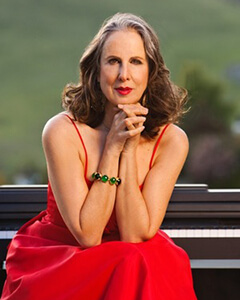
Marian Drandell Gilbert, pianist, received her BM degree from UCSB and her Masters in piano performance from the Manhattan School of Music. She has twice attended the Music Academy of the West. She maintains a private teaching studio in San Luis Obispo, where she lives with her husband and two children. She is a soloist with the San Luis Chamber Orchestra and is on the Board of Directors of the SLO Symphony Orchestra.
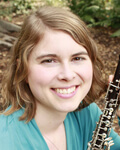
Adelle Rodkey, oboist, received her BM Degree in Music Pedagogy, magna cum laude, from Wheaton Conservatory of Music (Illinois), where she studied oboe with Carl Sonik. A native of Santa Barbara, she was an oboe student of Anne Anderson and a piano student of Lana Bodnar and Marilyn Clemons. Honors accorded her have included the President’s Award from Wheaton College, as well as awards from the Music Teachers National Association and the Pillsbury Foundation. Adelle performs frequently in several orchestras and chamber music ensembles, and is Instructor of Oboe at Westmont College. As a member of the Suzuki Association of the Americas, she maintains a private studio of oboe and piano students.
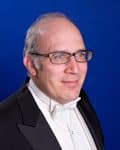
A native Manhattanite, Eric Valinsky has, for more years than he would like to admit, maintained dual careers in computer systems architecture and music. He was educated at the Oberlin Conservatory of Music and the University of Illinois, finally achieving his DMA in music composition from Columbia University. He studied composition with Walter Aschaffenburg, Salvatore Martirano, Jack Beeson, and Darius Milhaud; piano with Sara Crawford Drogheo and Emil Danenberg; and conducting with Harold Farberman. While living in Los Angeles, he became music director and composer-in-residence for The Storie-Crawford Dance Theatre Ensemble. Returning to New York, he served in a similar capacity for Danny Buraczeski’s Jazzdance, Uris Bahr and Dancers, and The New American Ballet Ensemble as well as composer-in-residence for The Rachel Harms Dance Company, Opera Uptown, and the Dance Department at City College of New York. He is currently Music Director for the American Dance & Music Performance Group and moonlights as founder and partner of Inlineos LLC, a strategic Internet consulting company.
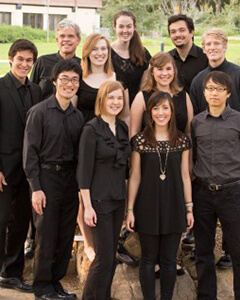
The Westmont Chamber Singers, Grey Brothers, director, is a select ensemble drawn from the Westmont College Choir. The ensemble offers elite, small-vocal-ensemble experience to advanced singers who wish to explore challenging literature written for few voices per part, and specializes in sacred and secular music from the 15th century to present-day. Their repertoire includes madrigals and motets of the Renaissance, contemporary sacred and secular music, folk-song arrangements, spirituals, and present-day jazz and pop music, as well as early Spanish choral music from Mexico and the United States. The ensemble comprises soprano: Lillyana Huerta, Bethany Le, Jessica Lingua; alto: Sharon Ko, Justice Patocs, Naomi Pulver, tenor: Christopher Browning, Kenny Galindo, Fritz Mora; bass: Alex Dell, Sean McElrath, Nathan Sirovatka.
This concert in the Faulkner Gallery is being presented through a partnership with the Santa Barbara Public Library.