

Image: Johannes Brahms | Public Domain
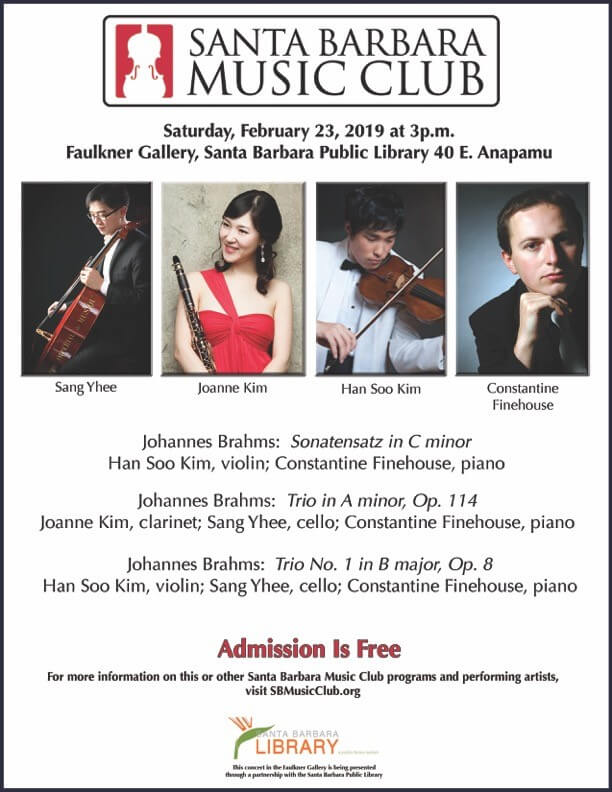
On Saturday, February 23 at 3 p.m. the Santa Barbara Music Club presents another program in its popular series of concerts of beautiful Classical music. This afternoon, pianist Constantine Finehouse, clarinetist Joanne Kim, violinist Han Soo Kim, and cellist Sang Yhee present “Johannes Brahms in Retrospect.” This program features bookend works of the composer’s life: two from his early twenties – Piano Trio No. 1 in B major, Op. 8, and Sonatensatz for violin and piano; the third Brahms wrote at at 58 years old, the Clarinet Trio in A Minor, Op. 114. This concert, co-sponosred by the Santa Barbara Public Library, will be held at the Faulkner Gallery of the library, 40 East Anapamu, Santa Barbara. Admission is free.
Program Details
Constantine Finehouse, piano
- Allegro
- Adagio
- Andantino grazioso
- Allegro
Sang Jun Yhee, cello
Constantine Finehouse, piano
- Allegro con brio
- Scherzo: Allegro molto
- Adagio
- Finale: Allegro
Sang Jun Yhee, cello
Constantine Finehouse, piano
Notes on the Program
By all accounts, performers and scholars of Western music consider Johannes Brahms (1833-1897) a towering figure of the Romantic era. Curiously, reception has given him the reputation of being the torch bearer of tradition. To some he is the number-one contender for heir to the Beethoven symphony. To others, he links the First Viennese School of Haydn, Mozart, and Beethoven with the Second Viennese School of Schoenberg, Berg, and Webern. Perhaps most popularly, Brahms became the poster child for so-called “absolute music” during the 1860s, which ideologically pitted him against the representational or “program music” composers the New German School – Liszt, and, of course, Wagner. While these stories reflect some truth about the history of Western music and of Brahms, they tend to explain him through other composers or as a piece in the “evolution” of music. But his music is far more complex, multifaceted, and dynamic than these tired tropes may have us believe. This afternoon’s concert focuses on chamber music, one of the most significant contributions of Brahms. Today’s selection allows us to examine the beginning and end of his compositional life. The program includes two early works, the Piano Trio No. 1 in B major, Op. 8, and Sonatensatz for violin and piano, which Brahms composed in his early twenties. The final work is the Clarinet Trio, Op. 114, which Brahms wrote at at 58 years of age.
The Sonatensatz, although a short and youthful work, tells some important stories about the life and development of Brahms. This piece marks his meeting and the beginning of his life-long friendship with the Schumanns. Indeed, his relationship to Robert and Clara has become one of the most well-known, collaborative, and fruitful relationships documented in Western music. Moreover, the Sonatensatz also put Brahms on the musical map, as it were, as Robert Schumann wrote accolades about it and him in the music periodical “Neue Zeitschrift für Musik” (“New Journal for Music”). Finally, the piece also marks the beginning of an even closer collaborative relationship between Brahms and the violinist Joseph Joachim. All these relationships and professional advancements developed in the spring of 1853, when Brahms was a mere 20 years of age. The piece’s so-called title literally translates to ‘sonata sentence,’ as it functions as one movement of a co-composed violin and piano sonata. Brahms, Schumann, and the young composer-conductor Albert Dietrich each wrote movements to what is known as the “F.A.E. Sonata” dedicated to Joachim. The abbreviation F.A.E. stands for Joachim’s motto: Frei aber einsam (free but lonely). Brahms supplied the scherzo, the fast, dance-like movement, which Han Soo Kim and Constantine Finehouse perform this afternoon. At an early age, Brahms found himself part of an important musical community, one that shaped him and that he helped shape as he matured. And the Sonatensatz documents its beginning.
Later that year, Brahms wrote Piano Trio No. 1 in B major, Op. 8. It is difficult to determine with certitude to which genre Brahms contributed most or to which genre he figures most importantly. Yet he wrote some of his most memorable works for chamber ensembles; the B-major trio stands as one of the earliest and most beautiful examples. The piece, however, shows us two sides of Brahms. He wrote it in 1853, which imbues the piece with youthful adventure, anxiety, and tension – most appropriately demonstrated in the primary theme of the first movement. Brahms also revised the work substantially in 1889, which gives the piece retrospect and tightening of his motivic work. He at first was ambivalent towards revising the work, since Op. 8 represented the last of his compositions informed by Liszt’s conception of thematic transformation. Indeed, Op. 8 demands careful listening as main themes transform subtly throughout; however, the way in which they transformed bore stamp more of Liszt than of Brahms. So the 1889 revisions put more of a mature “Brahms” into a younger “Brahms” piece, a practice in thematic transformation on his own terms. Luckily for us, Brahms preserved both versions, a rarity considering how critical he was of his work and how often consigned manuscripts to the fire. Han Soo Kim, Sang Yhee, and Constantine Finehouse perform the revised version this afternoon.
The 1889 revisions of Op. 8 place it far closer in proximity to the latest work of today’s program, the Clarinet Trio in A Minor, Op. 114, which combines the sumptuous timbres of piano, cello, and clarinet, performed respectively by Constantine Finehouse, Sang Yhee, and Joanne Kim. Brahms began composing for the clarinet as a solo instrument in 1891, shortly after his fifty-eighth birthday and in his twilight years. In fact, by 1891, Brahms had not composed anything in well over a year. Yet when he heard the esteemed clarinetist Richard Mühlfeld perform, his creativity exploded with a series of works featuring the instrument. The most celebrated among these are the Quintet for Clarinet and Strings, Op. 115, and the two sonatas for clarinet and piano Op. 120. Yet the Op. 114 trio began the flurry of works. Scholars often cite Op. 114 as among the “coldest” and “austere” Brahms wrote, as lush melodic passages become less important than harmonic progression and contrapuntal devices like the canon. Scholars also suggest Brahms simply did not care about pleasing the public with this collection of late works, which gives this afternoon’s program quite a historical and personal spectrum. From the collaborative and social Sonatensatz to the working out of compositional influences in Op. 8, we come towards the end of Brahms’s life in Op. 114, where “lateness” seems to equate with interiority, reflection, and a personal statement unaffected by the lure of professional or historical elevation. In any case, we have the fortune of experiencing in vignette the musical life of Brahms as one figure within an ever-changing, ever-growing musical landscape during the Romantic period.
The Performers
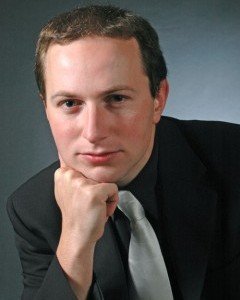
Constantine Finehouse was born in St. Petersburg, Russia, and attended New England Conservatory, Juilliard and Yale. His principal teachers included Fredrik Wanger, Natalia Harlap, Herbert Stessin, Jerome Lowenthal, Boris Berman and Bruce Brubaker. Praised by Rhein Main Presse Allgemeine Zeitung for his “interpretations of depth and maturity,” Finehouse has performed extensively in the US (including in California, Colorado, Connecticut, Florida, Georgia, Massachusetts, New York, Rhode Island and Washington) and abroad (including in Lausanne, London, Odessa, St. Petersburg and Trieste). Recent recordings include Backwards Glance [Spice Rack Records 101-01], which interweaves music of Johannes Brahms and Richard Beaudoin. The Bolcom Project, made in collaboration with his American Double partner, violinist Philip Ficsor, included double-CD [Albany Troy 959/960] and a national tour. Fanfare praised the recording as “indispensable to any serious collector with an interest in later 20th century duo repertoire for violin and piano.” As part of American Double, Finehouse also toured Hungary, performing sonatas by Brahms, Bolcom and Ravel. More recently, he collaborated with violinist Olga Caceànova at Lausanne Conservatoire and with cellist Sebastian Bäverstam at Weill Recital Hall (Carnegie Hall) and Merkin Recital Hall (Kauffman Center). Finehouse is currently recording Bolcom’s complete piano solo works for Naxos Records.
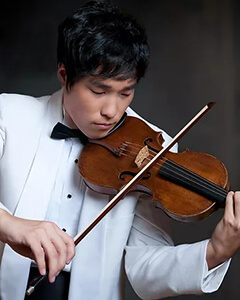
Han Soo Kim, violinist, is an award-winning and internationally accomplished artist who has performed to critical acclaim in numerous countries on four continents. Dr. Kim has concertized extensively as solo performer, duo-recitalist and chamber musician. In the United States, he has performed in some of the nation’s most prominent venues including Alice Tully Hall, Avery Fisher Hall, Boston Symphony Hall, Weill Recital Hall and Isaac Stern Auditorium at Carnegie Hall, Cutler Majestic Theater, Jordan Hall, Kaufmann Concert Hall, and The Kennedy Center. Performances have also led him to institutions and festivals including Académie Internationale de Courchevel, Boston Conservatory, Columbia University, Le Domaine Forget International Music Festival, The Juilliard School, Longy School of Music, Manhattan School of Music, Mannes College, Meadowmount School of Music, Morningside Music Bridge, Musicorda, New England Conservatory, and Stony Brook University. He has appeared as soloist with orchestras in the US and abroad performing standard concertos to contemporary world premieres. As a Promessa Records Artist he has released Encore Favori, a solo CD featuring a dozen encores and virtuosic showpieces, and will be recording the next album in 2021. He is Founder and the violinist of The Finehouse-Kim-Yhee Trio.
Dr. Kim has earned his Doctor of Musical Arts in violin performance under a fellowship grant. His Bachelor of Music and Master of Music degrees in violin performance are from The Juilliard School where he was a merit scholarship recipient. His influential teachers and mentors include Roman Totenberg, Sally Thomas, and Pamela Frank. He has worked with distinguished chamber music artists including Emerson, Guarneri, Juilliard, and Orion String Quartets. He is a Bella Rosins Artist and performs on a Carlo Antonio Testore of 1721. His CDs can be purchased at the Westmont College bookstore and hanjoannekim.com. In his spare time, he enjoys spending time with his wife, son Kian and dog Dolce, exploring restaurants in Santa Barbara, playing pool, and gardening.
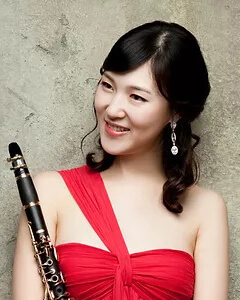
Clarinetist Joanne Kim, has concertized as solo performer and chamber and orchestral musician in many parts of North America and Asia. Her performing career began in her late teens with the honorable Stamas Scholarship Fund from the New York Philharmonic offering her a new clarinet for her studies and concerts. She has performed with New York Soloist Ensemble, Toronto Symphony Orchestra, Korean Chamber Orchestra, Astoria Symphony, New Jersey Philharmonic Orchestra, Chelsea Symphony, and the Santa Barbara Symphony. Dr. Kim has earned her Doctor of Musical Arts in clarinet performance at Manhattan School of Music with a fellowship under the tutelage of Mark Nuccio. Her Bachelor of Music is from Mannes College, and Master of Music degree with merit scholarship in the prestigious Orchestral Performance Program is from Manhattan School of Music. Dr. Kim is on the faculty at Westmont College, Santa Barbara City College, Westmont Academy for Young Artists, and InterHarmony International Music Festival in Italy.
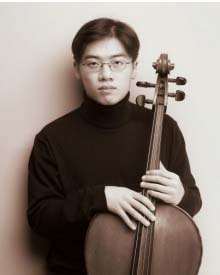
Sang Jun Yhee, cello (Tenafly, New Jersey), pursued his studies at the Juilliard School in New York under the tutelage of Joel Krosnick, Harvey Shapiro, and David Soyer. He has also studied with David Geringas in masterclasses at the Chigiana Academy in Siena, Kronberg Academy, Interlaken Classics, and Usedom Music Festival. He will be pursuing his doctorate at Manhattan School of Music in the fall. Sang has won the Juilliard School Shostakovich Cello Concerto Competition and has been a quarter-finalist at the Concours de Genève in Geneva, Switzerland. He also won first place at the Thavieu String Competition, the Society of American Musicians Competition, and is a recipient of the 2013 Frank Huntington Beebe Fund. He has performed as soloist with the New Jersey Symphony Orchestra, Juilliard Pre-college Orchestra, World Youth Symphony Orchestra, and the Northshore Orchestra. Past Yellow Barn musician (2013-2014)
This concert in the Faulkner Gallery is being presented through a partnership with the Santa Barbara Public Library.