

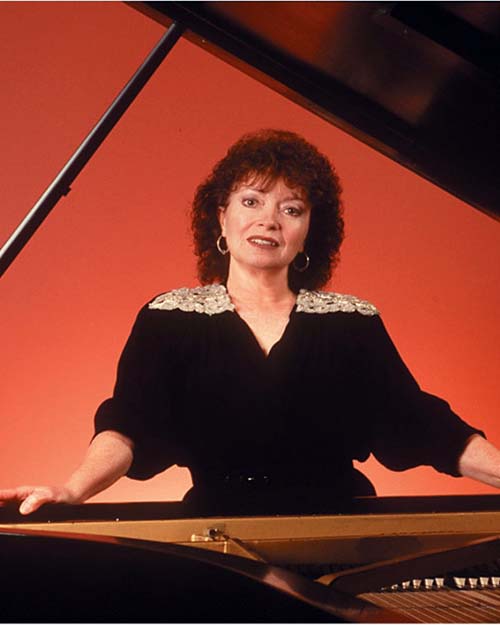
Image: Betty Oberacker, pianist
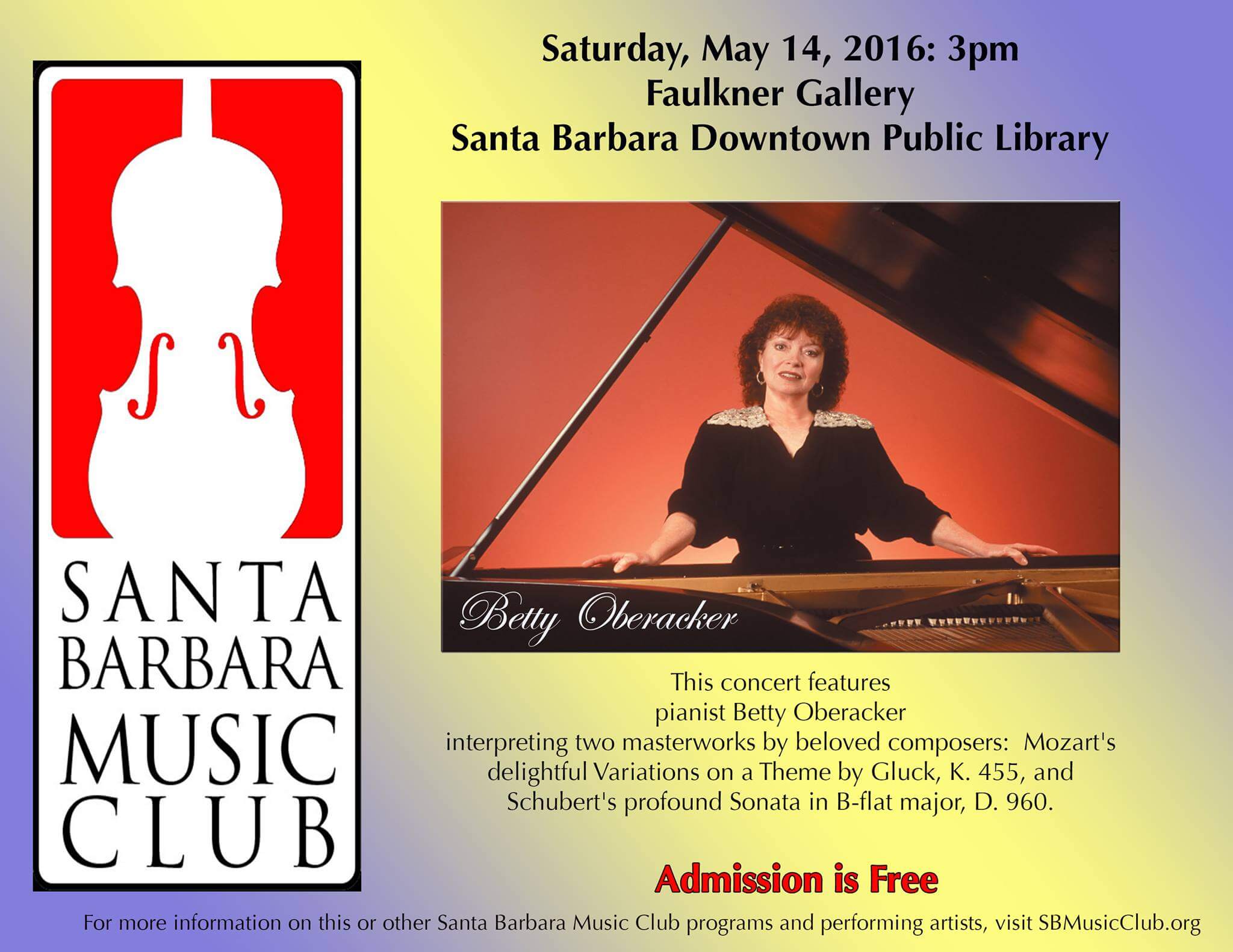
On SATURDAY, MAY 14 at 3 p.m. the SANTA BARBARA MUSIC CLUB will present another program in its popular series of concerts of beautiful Classical music at Faulkner Gallery in the downtown Public Library. This concert features internationally renowned pianist Betty Oberacker in a program featuring masterworks by Mozart and Schubert.
Program Details
(1756-1791)
(1797-1828)
- Molto moderato
- Andante sostenuto
- Scherzo: Allegro vivace con delicatezza
- Allegro ma non troppo
Notes on the Program
One of the highlights of Santa Barbara Music Club’s concerts is the opportunity for audiences to hear great music from a variety of historical periods, with a diversity of musical forms, performed by excellent artists. This concert features internationally renowned pianist Betty Oberacker in a program featuring masterworks by Mozart and Schubert.
The program opens with Wolfgang Amadeus Mozart’s delightful – but seldom performed – Variations in G major on a Theme by Gluck, K. 455. The work was written in 1783, just after Mozart had returned from six triumphant weeks in Prague, where he had finally been accorded the kind of musical success he had so long sought, and it was this background of elation and gratitude in which he composed these ten variations on an aria from Gluck’s comic opera, Die Pilgrimme von Mekka (The Pilgrims of Mecca); Mozart was obviously taken with the sarcasm and lightheartedness of the aria “Unser dummer Pöbel meint,” which loosely translates to “Our Stupid Rabble Believes.” It is known that Gluck and Mozart were on very friendly terms, and the variations were composed as a tribute to his older colleague, who had praised Mozart’s operas.
Conceived on a large scale, the dramatic score features brilliant as well as sensitive elaborations of melodic lines and accompanying figurations, all proceeding inexorably toward a highly ornamented final display of unabashed virtuosic splendor, replete with bravura cadenzas and all-round wonderfully good-humored character.
The concluding work, Sonata in B-flat major, D. 960 of Franz Schubert, could not be more contrasting: written in 1828, in the last months of Schubert’s life, its profoundly philosophical nature, its deeply felt seriousness and emotional intimacy, and its impressive spaciousness culminate in a structure not merely of impressive dimensions but of supreme import. Musicologist Donald Tovey’s observation that “the length of Schubert’s big movements is not actually greater than their openings imply” is nowhere more telling than in this sonata, the last piano work Schubert would ever write.
The first movement, Molto moderato, opens with a statement of utter simplicity, and yet a more portentous unfolding of a sonata could not be imagined. The sense of sustained grandeur and nobility which pervades not only the massive initial statement but the entire sonata is surely unsurpassed in the entire keyboard literature. Indeed, its nearest relative, particularly with regard to the exquisitely poignant slow movement, Andante sostenuto, would have to be the composer’s own String Quintet in C major, Op. 163, composed only a few months afterward and Schubert’s final composition in sonata form. The sonata’s third and fourth movements, Scherzo: Allegro vivace con delicatezza and Allegro ma non troppo, respectively, have an obviously genial Austrian folksong influence, yet they both integrate in and provide balance to the weighty sensibility of the whole.
The Performer

Betty Oberacker, pianist, is internationally acclaimed for her interpretations of both traditional and contemporary solo and chamber music repertoire, and has toured throughout Europe, Israel, Asia, Australia, New Zealand, Mexico and the U.S., including performances at Carnegie Hall, Amsterdam Concertgebouw, Berlin Philharmonic Hall and Vienna Musikverein. She has been Artist-in-Residence at 55 universities, conservatories and music festivals worldwide, and many important composers have dedicated their compositions to her. Her musical gifts were evidenced at three, when she began to play the piano and compose entirely by ear. Piano lessons started at age seven, and at nine she was accepted on scholarship as the only child student of the noted pianist Beryl Rubinstein. Her BM/MM Degrees are from the Cleveland Institute of Music, and her DMA Degree is from Ohio State University, where she was concomitantly a member of the piano faculty. Her discography includes Bach’s Well-Tempered Clavier (Clavier Records), A Bach Commemorative Recital (MIT Great Performances Archives), Chamber Music of Emma Lou Diemer (Orion), Schönberg’s Pierrot Lunaire (Century), John Biggs’ Variations on a Theme of Shostakovich (VMM), and Diemer’s Piano Concerto (MMC), the latter two works composed for Oberacker. Honors accorded her include a Fulbright Research Fellowship to Italy and the University of California Distinguished Teaching Award, and her students hold important positions as performers and teachers in the U.S., Asia and Europe. Dr. Oberacker is UCSB Professor Emeritus, and enjoys an active performing, teaching and chamber music coaching schedule.