

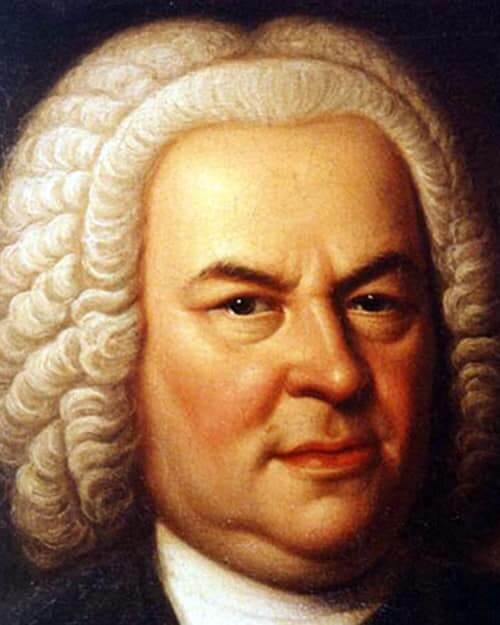
Image: Johann Sebastian Bach by John Huxley | Public Domain
In this concert, pianist Betty Oberacker will perform three major keyboard compositions from the greatest master of the Baroque Period, Johann Sebastian Bach (1685-1750). The concert opens with the radiant Toccata in D major, BWV 912. The dramatic English Suite in A minor, BWV 807 follows, brilliantly displaying Bach’s prowess in delineating the qualities of each of the traditional dance forms which comprise the Baroque Suite. Concluding the program is the mighty Chromatic Fantasia and Fugue, BWV 903, surely one of the most spectacular works Bach ever composed.
Program Details
- (Presto) – Allegro – Adagio – Fuga
- Prelude
- Allemande
- Courante
- Sarabande
- Bourée I and II
- Gigue
Notes on the Program
Putting together a program to highlight a single composer is always a challenge. Of that process, Dr. Oberacker said the following:
Bach’s works are of course an embarrassment of riches, and planning a program of his keyboard music is a deliciously frustrating undertaking! I eventually selected three compositions of different forms and tonalities, works which would display various aspects of the composer’s glorious use of the keyboard, his intricate understanding of both its virtuosic and expressive capabilities.
The concert opens with the radiant Toccata in D major, BWV 912. The work features four interconnected and highly contrasting sections, with the first three flowing inexorably into the final segment — surely some of the most joyous and exhilarating music ever composed.
The English Suite in A minor, BWV 807 follows, brilliantly displaying Bach’s prowess in delineating the qualities of each of the traditional dance forms which comprise the Baroque Suite. Prefaced by a spirited and buoyant Prelude, the six dances (Allemande, Courante, Sarabande, Bourée I and II, Gigue) evoke the dichotomy between the graceful and severe, the formal and relaxed, so inherent in the economic and social structures of the time as well as in Bach’s compositional style.
The program concludes with the mighty Chromatic Fantasia and Fugue, BWV 903. The Fantasia is indeed a fantasy in the freest sense, improvisatory not only in its seemingly random and often rapid changes of character and keyboard patterns, but in the interpolation of several sections consisting only of block chords, which the artist must interpret according to his tastes and abilities: this was obviously a harkening back to styles he inherited from the past, in which composers often only sketched their musical ideas, utilizing techniques such as figured bass (a shorthand notation indicating the intended harmony, rather than the actual notes to be played), and leaving the realizations to the performers.
Among the striking features of the Fugue is its subject, or theme — the building block of the entire piece — beginning with four notes which are an anagram of the letters of Bach’s name: A, B-flat, B, and C, with B = H and B-flat = B in the German spelling. With this auspicious foundation, Bach constructs complex and daring architecture, replete with audacious-for-the-time harmonic dissonances and marvelously expressive emotional effects, all culminating in a composition renowned for its impressively forward-looking originality. Truly a unique masterpiece from a truly unique master.
This project is funded in part by the Community Arts Grant Program using funds provided by the City of Santa Barbara in partnership with the Santa Barbara County Arts Commission.