

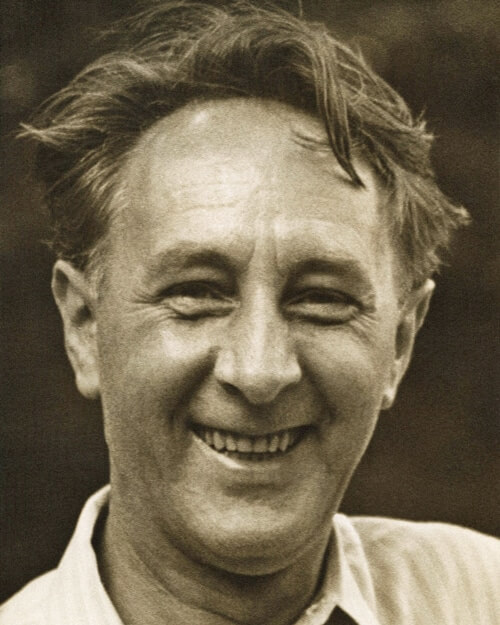
Image: Bohuslav Martinů Autor: Neznámý – Bohuslav Martinu Centre in Policka
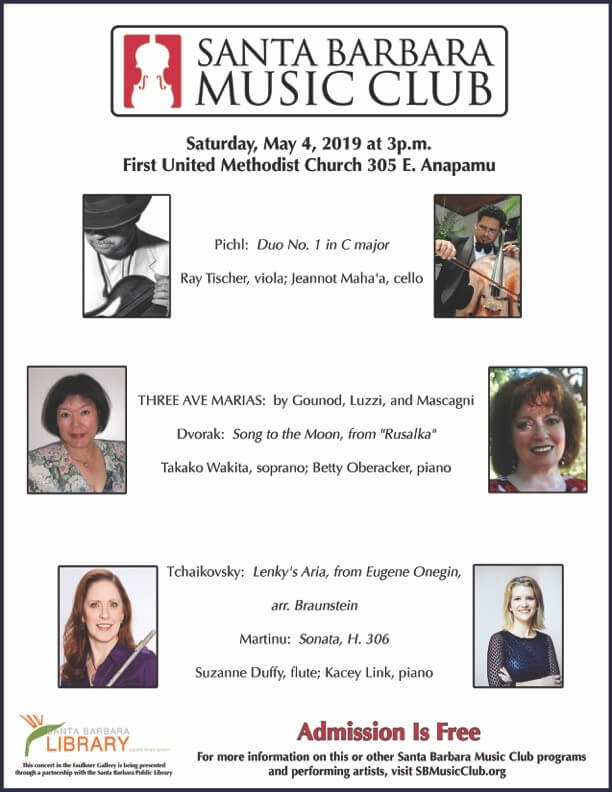
On Saturday, May 4 at 3 p.m. the Santa Barbara Music Club will present another program in its popular series of beautiful classical-music concerts. This afternoon’s roster features the Wenzel Pichl Duo No. 1 in C Major performed by violist Ray Tischer and cellist Jeannot Maha’a. Next, soprano Takako Wakita and pianist Betty Oberacker perform three nineteenth-century settings of the “Ave Maria” text by Charles Gounod, Luigi Luzzi, and Pietro Mascagni, concluded by the famous “Song to the Moon” from Antonín Dvořák’s opera Rusalka. Finally, flautist Suzanne Duffy and pianist Kacey Link present Braunstein’s instrumental arrangement of “Lensky’s Aria” from Tchaikovsky’s Eugene Onegin and conclude with the Sonata for Flute and Piano, H. 306 by Czech composer Bohuslav Martinů. This concert will be held at First United Methodist Church, 305 E. Anapamu St., Santa Barbara. Admission is free.
Program Details
(1741-1805)
Jeannot Maha’a, cello
(1841-1904)
Betty Oberacker, piano
(1890-1959)
- Allegro moderato
- Adagio
- Allegro poco moderato
Kacey Link, piano
Notes on the Program
The Czech composer Wenzel Pichl (1741 – 1805) rubbed shoulders with many fellow composers and patrons in both the Viennese and Eastern European landscapes of the late-eighteenth century. In addition to composing predominantly instrumental music – symphonic, chamber, and solo pieces – he also played the violin, was involved in music theater, and often took jobs copying symphonies of Haydn, Dittersdorf, and Gassmann. In addition, like Haydn, Pichl worked for a time for the Esterházy family. It may come as no surprise, then, that Pichl’s music has an elegance and formal transparency like that of his more well-known contemporaries. This afternoon, violist Ray Tischer and cellist Jeannot Maha’a showcase the versatility of Pichl’s instrumental writing with the Duo No. 1 in C Major. Pichl’s music plays with convention as he imbues into this duet procedures one would normally hear in the concerto. Finally, Pichl balances well the clarity of a galant melodic line with Italianate virtuosic string writing.
Soprano Takako Wakita and pianist Betty Oberacker demonstrate how various composers of the nineteenth century treated the Marian text Ave Maria. The first is by Luigi Luzzi (1827 – 1878), who, unlike the following two, did not use pre-existing music. While known primarily throughout his life as a composer of melodrama and opera, his setting of Ave Maria consists of ultra-Romantic harmonies supporting a vocal line one might mistake for an aria, as opposed to a liturgical text. The next piece enjoys the reputation as one of the two most popular settings of the text in Western music. When people think of Ave Maria, chances are they think either of the piece by Franz Schubert (1797 – 1828) or by Charles Gounod (1818 – 1893). The latter shows the composer’s adopting the melody of J.S. Bach’s C-major prelude of the Well Tempered Clavier, Book I. Gounod composes a placid, lyrical melody over the constantly moving notes of the accompaniment. The last setting is an arrangement by Piero Mazzoni of Pietro Mascagni’s (1863-1945) beloved “Intermezzo” from Cavalleria Rusticana. While the first two settings emerge from the Italian High Romanticism, the last one indicates the Romantic movement in decline with Italian verismo (or “realism”). This may explain in part why the “Intermezzo” music supporting the Marian text has a twinge of sadness or melancholy.
The final vocal piece on this afternoon’s program enjoys prestige as one of the most memorable arias in the repertoire, “Song to the Moon” from the opera Rusalka by Antonín Dvořák (1841-1904). The opera itself comes from a Czech supernatural fairy tale, which represents the polar opposite of the liturgical Ave Maria text. Rusalka, the water nymph, wants to be human because she has fallen in love with a prince. This aria occurs when she asks the moon to reveal her love for the prince.
The other opera represented in today’s program is the 1879 Eugene Onegin by Pyotr Ilyich Tchaikovsky (1840 – 1893). Although it took some years to gain affection among audiences outside its native Russia, Eugene Onegin today occupies a place in the standard opera repertory. The opera, based on the verse novel by Alexander Pushkin, is more or less a study in emptiness and remorse. For example, the characters of Onegin and Lensky are best friends. Through a series of unfortunate events – Lensky inviting Onegin to a party under false pretenses, and Onegin exacting revenge by advancing on Lensky’s love Olga – the two characters are embroiled in a gun duel. “Lensky’s Aria,” arranged for flute and piano by Guy Braunstein, adapts the eponymous character’s moment of reflection before the duel with Onegin. He resigns himself to the likelihood of dying and the bitterness of never again seeing his beloved Olga. This afternoon flautist Suzanne Duffy and pianist Kacey Link relay in kind the melancholy and remorse of the aria, so typical of the ultra-realism Tchaikovsky imbued into his operas.
Duffy and Link conclude this afternoon’s program with the evocative Sonata for Flute and Piano, H. 306 by the modern-classical Czech composer Bohuslav Martinů (1890 – 1959). It may or may not come as evident to listeners that Martinů composed the work while in exile. The composer, living in France, fled the country after its occupation by Nazi Germany in 1941, and he settled for some years along the Northeast Coast of the USA – New York City to be exact. While in the states, Martinů composed most of his symphonic music, along with some notable chamber music. He composed the flute and piano sonata around the time he finished his Fourth Symphony, and his Czech Rhapsody in the summer of 1945, which was around the time he visited Cape Cod. As regards his musical style, scholars have documented his adoption of Stravinsky-ian neoclassicism with respect to formal organization. Others have noted Martinů’s sound as a cross between that of Bartok and Prokofiev, respectively the commixture of native folk melodies with pan-tonal harmony.
The Performers
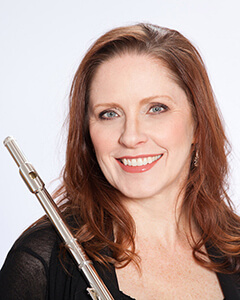
Suzanne Duffy, flutist, is an active soloist and chamber musician, serves as Principal Flute for San Luis Obispo County’s Symphony of the Vines and Opera San Luis Obispo, is Second Flute/Piccolo for Opera Santa Barbara, and maintains a private teaching studio. She earned her MM Degree from Indiana University and her BM Degree from Northwestern University. A Cal Poly-San Luis Obispo faculty member since 2015, in March 2020 Suzanne will be featured faculty soloist with the Cal Poly Wind Ensemble in Stephen Bulla’s Rhapsody, and will present a repeat performance at the University of Puget Sound, Seattle.
Kacey Link is a pianist and scholar residing in Santa Barbara, CA. As a both a solo and collaborative artist, she performs regularly in Southern California and has given recitals in the United States, France, and Switzerland. She is a pianist for University of California—Santa Barbara Department of Theater and Dance and served as music director for Out of the Box Theatre Company for the 2014-2015 season. She also has worked as a pianist for Opera Santa Barbara, Kansas City Lyric Opera, and New Theatre of Kansas City as well as accompanied classes for such prestigious artists as Marilyn Horne, Yo-Yo Ma, and ballerina Heather Watts. As a scholar, her research focuses on the music of Latin America with specific concentration on tango music of Argentina and has co-authored the forthcoming book Tracing Tangueros: Argentine Instrumental Tango Music (Oxford University Press). She holds degrees from University of California – Santa Barbara (D.M.A. in Keyboard), University of Miami (M.M. in Musicology), and University of Kansas (M.M. in Accompanying, B.M. in Piano Performance).
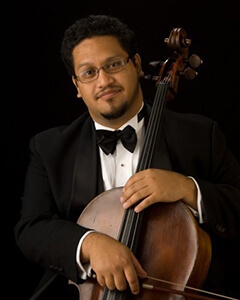
Jeannot Maha’a, cellist, is a specialist in historical performance practice on original instruments and studied at the Oberlin Baroque Performance Institute. In 2010 he founded Editions Violone, a Santa Barbara-based publishing house specializing in scholarly performing editions of rare and little-known music of the 17th, 18th, and 19th centuries, and currently heads an international team of musicologists in the search for forgotten music. Mr. Maha’a maintains a private cello and bass studio in SB, and performs on an Italian cello made in 1766.
Betty Oberacker, pianist, is internationally acclaimed for her interpretations of both traditional and contemporary solo and chamber music repertoire, and has toured throughout Europe, Israel, Asia, Australia, New Zealand, Mexico and the U.S., including performances at Carnegie Hall, Amsterdam Concertgebouw, Berlin Philharmonic Hall and Vienna Musikverein. She has been Artist-in-Residence at 55 universities, conservatories and music festivals worldwide, and many important composers have dedicated their compositions to her. Her musical gifts were evidenced at three, when she began to play the piano and compose entirely by ear. Piano lessons started at age seven, and at nine she was accepted on scholarship as the only child student of the noted pianist Beryl Rubinstein. Her BM/MM Degrees are from the Cleveland Institute of Music, and her DMA Degree is from Ohio State University, where she was concomitantly a member of the piano faculty. Her discography includes Bach’s Well-Tempered Clavier (Clavier Records), A Bach Commemorative Recital (MIT Great Performances Archives), Chamber Music of Emma Lou Diemer (Orion), Schönberg’s Pierrot Lunaire (Century), John Biggs’ Variations on a Theme of Shostakovich (VMM), and Diemer’s Piano Concerto (MMC), the latter two works composed for Oberacker. Honors accorded her include a Fulbright Research Fellowship to Italy and the University of California Distinguished Teaching Award, and her students hold important positions as performers and teachers in the U.S., Asia and Europe. Dr. Oberacker is UCSB Professor Emeritus, and enjoys an active performing, teaching and chamber music coaching schedule.
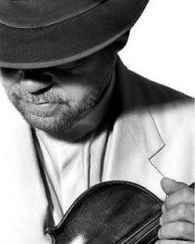
Ray Tischer, violist, has performed internationally and has recorded over 1500 soundtracks, TV series, commercials, and albums with Frank Sinatra, Barbra Streisand, and other notables. Dr. Tischer earned his DMA Degree from USC in viola and musicology, and is an avid practitioner of early music performance practice and jazz, in addition to being an Integrative and Music Therapist at Cottage Hospital. He performs on a Pietro Pallotta viola, made in Perugia, Italy in 1809, which he inherited from his mother, the esteemed violist Ann Tischer.
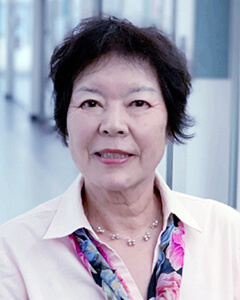
Takako Wakita, soprano, has appeared in both concerts and operas in the U. S. and abroad, including Madama Butterfly with the Japanese Philharmonic at Dorothy Chandler Pavilion in Los Angeles. She has also sung with Opera Santa Barbara, the Pacific Music Society, SB Choral Society, SB Civic Light Opera, and Ventura College Opera. She earned her BA Degree from Kyoiku University and her MA Degree from UCSB. Founder and current faculty member of the Japanese Language Program at SBCC, Professor Wakita also teaches for the SBCC School of Extended learning, is Chair of the Santa Barbara Sister Cities Board, and serves on the board of the Toba Sister City Organization, which promotes Japanese culture in Santa Barbara and sponsors a student exchange.