

Image: DeAndre Simmons | Used by permission
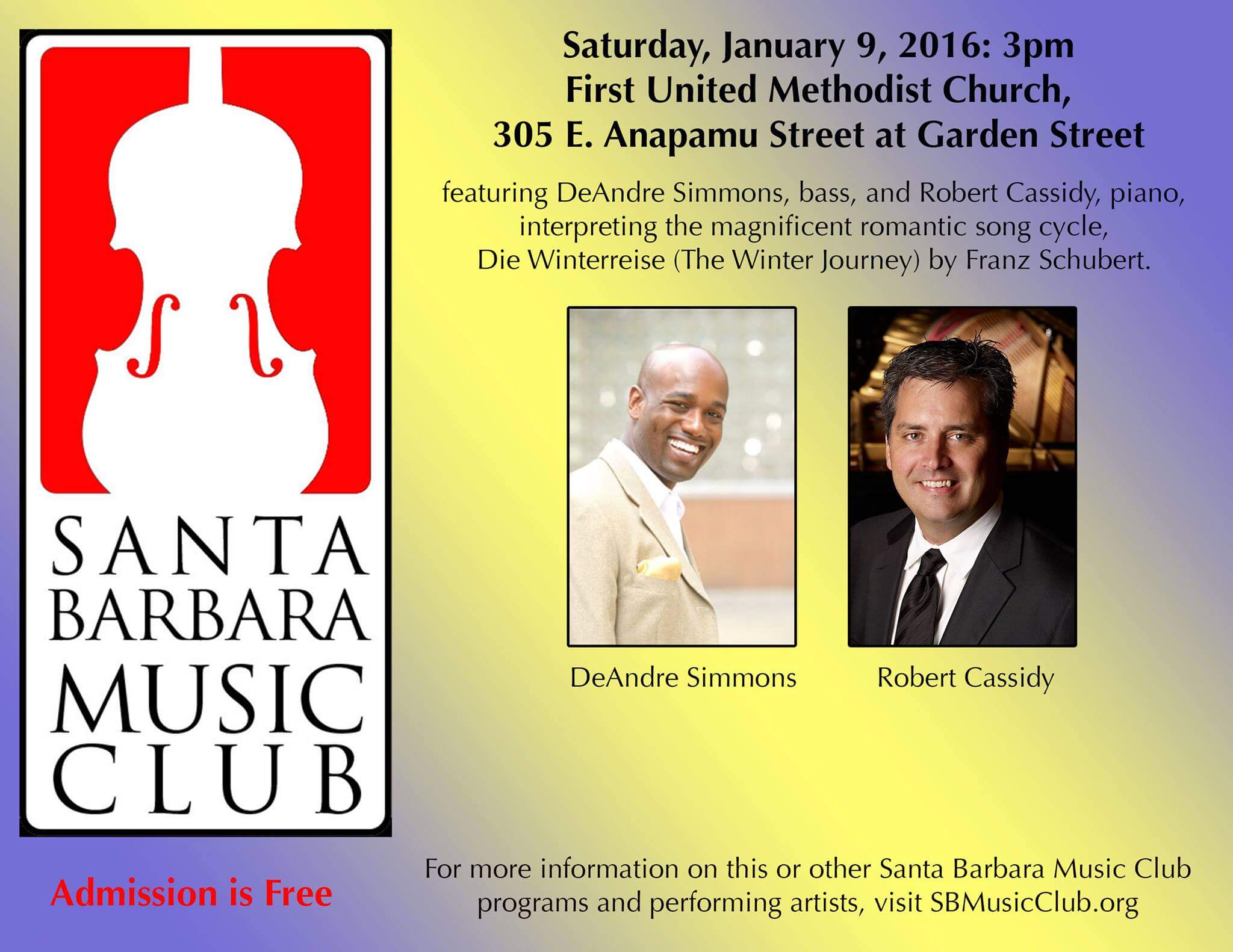
On SATURDAY, JANUARY 9 at 3 p.m. the SANTA BARBARA MUSIC CLUB will present another program in its popular series of concerts of beautiful Classical music at First United Methodist Church, Garden And Anapamu Streets.
One of the highlights of Santa Barbara Music Club’s concerts is the opportunity for audiences to hear great music from a variety of historical periods, with a diversity of musical forms, performed by excellent artists. This concert features the magnificent song cycle, Die Winterreise. by Franz Schubert, interpreted by DeAndre Simmons, bass, and Robert Cassidy, piano.
Program Details
(1797-1828)
- Gute Nacht (Good Night)
- Die Wetterfahne (The Weathervane)
- Gefror’ne Tränen (Frozen Tears)
- Erstarrung (Benumbed)
- Der Lindenbaum (The Linden Tree)
- Wasserfluth (Deluge)
- Auf dem Flusse (On the River)
- Rückblick (Looking Backward)
- Irrlicht (Will-o’-the Wisp)
- Rast (Rest)
- Frühlingstraum (Dream of Spring)
- Einsamkeit (Loneliness)
- Die Post (The Post)
- Der greise Kopf (The Grizzled Head)
- Die Krähe (The Raven)
- Letzte Hoffnung (Last Hope)
- Im Dorfe (In the Village)
- Der stürmische Morgen (The Stormy Morning)
- Täuschung (Illusion)
- Der Wegweiser (The Guidepost)
- Das Wirtshaus (The Inn)
- Muth! (Courage!)
- Die Nebensonnen (The Mock-Suns)
- Der Leiermann (The Organ-Grinder)
Robert Cassidy, piano
Notes on the Program
by Betty Oberacker
One of the highlights of Santa Barbara Music Club’s concerts is the opportunity for audiences to hear great music from a variety of historical periods, with a diversity of musical forms, performed by excellent artists. This concert features the magnificent song cycle, Die Winterreise by Franz Schubert, interpreted by DeAndre Simmons, bass, and Robert Cassidy, piano.
Die Winterreise (The Winter Journey) is one of Schubert’s most profoundly eloquent expressions, which is saying a great deal given the deeply emotional and intimately revealing nature of his entire creative output. Composed in 1827, Schubert’s musical settings of the twenty-four poems of Die Winterreise by the German lyric poet Wilhelm Müller bear witness to the close affinity felt by the composer with the unrelieved bleakness of the text, a synopsis of which is as follows:
A young man arrives in an idyllic town. There he befriends a family and is invited to live with them. He falls in love with the daughter and his love is returned, or so he is led to believe. However, the daughter rejects him to marry a wealthy suitor who has the approval of her parents. It is now winter, and despite the bitter cold the man leaves his adopted home in the dead of night, after writing a farewell message to his beloved. As he leaves the town, crows shower him with snow from the roofs.
He begins a most painful journey, constantly tortured by memories of his past happiness. On his travels he is joined by a raven (possible symbolic death wish). The song cycle ends with a particularly bleak image: an organ-grinder is plying his trade, ignored by the townspeople and harassed by dogs. It is ironic that in this final poem the poet asks if the organ-grinder will set the poet’s songs to music — an invitation that was ultimately accepted by Schubert.
We know that the composer worked on the cycle while in the throes of his final illness, and he is said to have remarked to his friends: “I will play you a cycle of terrifying songs; they have affected me more than has ever been the case with any other songs.”
And yet, the gloominess pervading the text notwithstanding, Schubert’s music achieves an unworldly aura of incredible beauty and passion, delineating with precise attention to detail the poet’s imaginative intent. Also notable is the fact that Schubert raises the importance of the pianist from a purely accompanimental role to one equal to that of the singer, not merely mirroring him but playing an integral part in the unfolding story of this emotional tour-de-force.
The Performers

DeAndre Simmons, bass, has gained international recognition for his wide-ranging repertoire of concert and operatic performances in the U.S. and Europe. A graduate of the Curtis Institute of Music, he also studied at the American Institute of Musical Studies in Graz, Austria. Honors accorded him include First Place Prize in both the George London Foundation Vocal Competition and the National Association of Teachers of Singing Competition, and he has been featured at Carnegie Hall in recitals and workshops, with the Opera Company of Philadelphia in the East Coast premiere of David DiChiera’s opera Cyrano, in The Beggar’s Opera by Benjamin Britten under Lorin Maazel, in Regina with the Pacific Opera Victoria, and with the Music Academy of the West Orchestra in both Aaron Copland’s Lincoln Portrait and the West Coast premiere of A Wedding by William Bolcom. He sang the Shepherd Boy in a recording of Tosca, performed in Aida, Carmen, Tosca, and Porgy & Bess, was a principal in the West Coast revival of A Bayou Legend by William Grant Still, and has sung for noted mezzo-soprano Florence Quivar (also his mentor). His singing credits in musicals including Showboat, Ain’t Misbehavin, The Wiz, Dream Girls, and Sweet Charity (in which he was also principal dancer), and his many television guest appearances and commercials include The Cosby Show and Sesame Street.
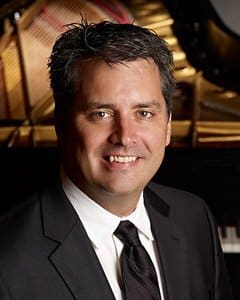
Pianist Robert Cassidy has performed in solo and collaborative recitals and with orchestra throughout the United States and Canada, and has received critical acclaim for his performances and recordings of both solo piano repertoire and chamber music. Dr. Cassidy has appeared in such venues as New York City’s Merkin and Weill Halls, the Lyceum in Alexandria (VA), Santa Barbara City College (CA), and the Banff Centre for the Arts in Alberta, Canada. He has also been presented on radio stations WFMT in Chicago (Dame Myra Hess Series), WCLV and WCPN in Cleveland, and WNYC in New York (Around New York). A strong advocate of contemporary music, Dr. Cassidy has premiered works by the American composers David Noon and Keith Fitch. He is the pianist in the Cleveland-based Almeda Trio and regularly performs chamber music with members of The Cleveland Orchestra.