

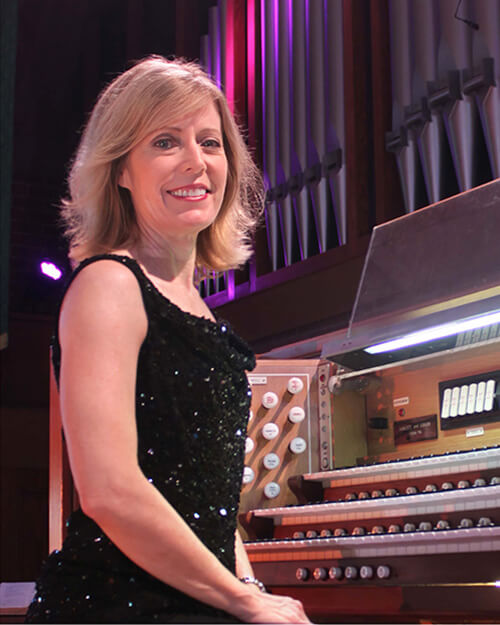
Image: Lynette McGee, organist
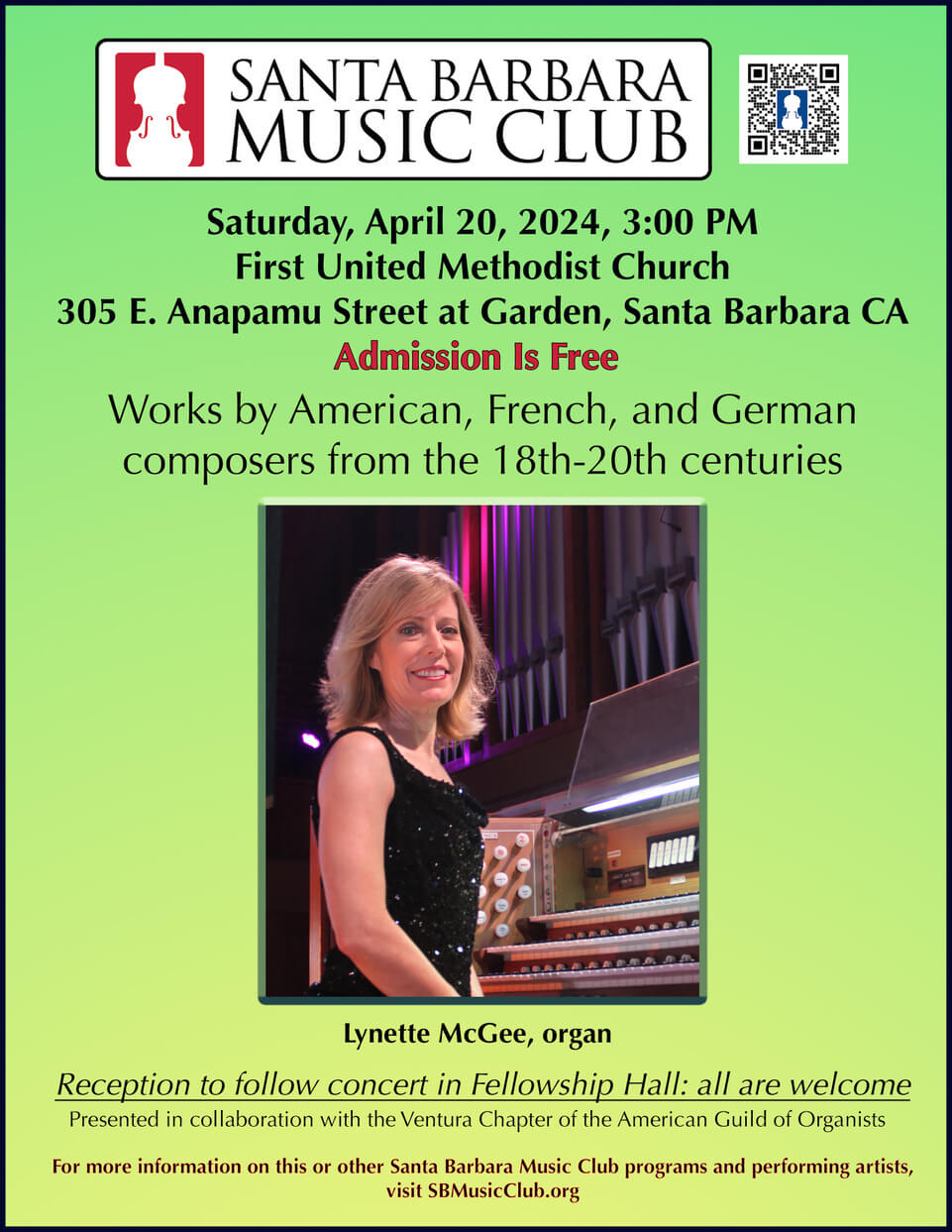
The Santa Barbara Music Club presents a program of exquisite classical music on Saturday, April 20 at 3:00 at First United Methodist Church, 305 E Anapamu St. featuring concert organist Lynnette McGee performing works by Max Reger, Johannes Michel, George Chadwick, Seth Bingham, Carson Cooman and Louis Vierne. The works selected for this recital are connected by the influence of one composer to another, fusion of cultural styles, and even through personal challenges and disappointments of life, all combining to bring about creative and emotive music.
Program Details
IT’S ALL CONNECTED
from Germany, America, and France
(1873-1916)
(b. 1962)
- Swing Five (Erhalt uns, Herr)
- Afro-Cuban (In dir ist Freude)
(1854-1931)
(1882-1972)
(b. 1982)
(1870-1937)
- Allegro maestoso
- Cantilène
- Intermezzo
- Adagio
- Final
Notes on the Program
We live in a world connected in a myriad of ways, and music is no exception. Influence of people, culture, time, and place all play a central role in the creation of art and music. The program of organ music chosen for this recital is connected by the influence of one composer to another, fusion of cultural styles, and even through personal challenges and disappointments of life, all combining to bring about creative and emotive music.
The celebrated German organist, composer and conductor, Max Reger (1873-1916) writes in a late Romantic style influenced by Brahms and Liszt, and rooted in the music of J.S. Bach. The development of the Rollschweller, a precursor to the modern crescendo pedal, was greatly appealing to Reger, making it possible to create huge crescendos and diminuendos. Reger chose the national anthem of the German Empire during the years 1871-1918, as the material for his Variationen und Fuge über “Heil unserm, König Heil,” published in Leipzig in 1901. A grand introduction begins the work, followed by a statement of the theme, accompanied by rich counterpoint. The variation moves the theme to the pedal, this time accompanied with tasteful suspensions and mild chromaticism. The fugue subject, an extraction of the first six measures of the theme, is presented multiple times, alternating between tonic and dominant. A restatement of the theme, complete with a brilliant pedal passage, brings the piece to a dramatic close.
George Whitefield Chadwick (1853-1931) was born of old New England families possessing musical abilities. He attended the New England Conservatory, studying organ and harmony with Dudley Buck and Elbridge Whiting. He was able to save enough money from his first church organ job to travel to Germany where he studied with August Haupt, Josef Rheinberger, and Gustav Merkel. Not long after his return to the states, Chadwick was invited to join the faculty of the New England Conservatory and in 1897, was appointed director of the New England Conservatory, a position he held until 1930. Chadwick was a prolific composer in large as well as small forms. In 1895, his former teacher, Dudley Buck, published an anthology entitled Vox Organi. This collection included four pieces by Chadwick, including the Pastorale. As the title suggests, Pastorale begins with an idyllic Andantino that soon rises into a more active section, typical of the usual rainstorm segment of the pastorale scenario, before returning to the idyllic flute-like conclusion.
Seth Daniels Bingham (1882-1972) was educated at Yale University, studying organ composition with Horatio Parker, with further study in Paris under the tutelage of Alexandré Guilmant and Charles-Marie Widor. Bingham taught theory, composition and organ at Yale, was a member of the music faculty of Columbia University and served as organist and music director at the Madison Avenue Presbyterian Church for 35 years. He was a prolific composer, composing music with rhythmic vitality, quasi-modal lines, and mildly chromatic contrapuntal textures. French and American styles converge in Roulade, composed in 1920. A lighthearted chromatic melodic theme sets Roulade in motion, followed by a fanfare theme, played on the trumpet. The crescendo pedal, a relatively new feature on organs of this period, provides the means for a dramatic crescendo which concludes the opening section. A lyrical melody then emerges, accompanied by the strings and vox humana, before returning to the opening themes. A coda, commencing with a chromatic scale and clever interjections from the pedal, brings the piece to a satisfying close.
The music of Carson Cooman (b. 1982) takes us into the 21st century. Cooman is an active concert organist who specializes in contemporary music. As a composer, he has written well over a thousand works ranging from solo instrumental pieces to operas, and from orchestral works to hymn tunes. He holds degrees from Harvard University and Carnegie Mellon University and has been composer-in-residence for the Episcopal Cathedral of St. Paul in Boston and the Memorial Church at Harvard University. His Toccata Festiva begins with a repeating figure in the late French Romantic toccata tradition while employing a American harmonic palette. Polyrhythm is employed when the pedal theme is introduced. A grand fanfare on the Reeds interrupt the toccata theme, which is followed by a short fugue featuring syncopation and more polyrhythm. A short transition moves us back to the toccata figures and main theme in the pedals before the exhilarating coda begins, building to a bombastic full organ ending.
French composer Louis Vierne is the foremost organ symphonist of the early twentieth century, composing six well-constructed organ symphonies from 1895-1931. He served as organist at Notre Dame de Paris from 1900 until his untimely death on the organ bench in 1937.
The Troisiême Symphonie in f-sharp Minor dates from the summer of 1911. Vierne began this major organ work at the urging of his friend who encouraged him to compose a third organ symphony. Vierne had suffered a tremendous disappointment in May of 1911, as he learned of the appointment of his colleague Eugene Gigout, as the organ instructor at the Paris Conservatoire. Not only was this a professional blow, but also a personal betrayal and humiliation by his friends Eugene Gigout and Gabriel Fauré. He spent the summer composing this symphony and finished the work in the autumn of 1911.
The symphony opens with an Allegro maestoso featuring an aggressive theme with jagged rhythmic edges and marcato articulation which pervades the movement. The second theme is lyrical, with the soaring melody accompanied with chromatically infused harmonies. The form is classical in nature, with two themes presented, developed in three key areas, and concluding with a restatement of the two themes, this time, both in F-sharp minor.
The second movement, Cantiléne, features a dreamy, lyrical melody winding its way in long phrases in the outer sections, contrasting a central homophonic episode. Throughout the movement, the harmony is colored with modal characteristics and chromaticism. The movement concludes with a coda utilizing modality and chromaticism to create a mystical and peaceful atmosphere, ultimately resolving to A major.
The Intermezzo is a delightful scherzo movement containing the rhythmic outlines of the opening theme of the Symphonie. They are cleverly transformed into an impish theme, again utilizing chromatic harmonies, but with an abundance of intervals of thirds, even in the pedals.
The fourth movement, Adagio, is built on a new, noble and tender melody that is expressively and artistically developed throughout the movement. The harmonies have a somewhat Wagnerian flavor, providing a rich, full sonority and rhythmic complexity in the use of triplets against duplets. Vierne utilizes a ternary form, saving the final statement of the opening theme for a soaring flute.
In the characteristic form of French organ symphonies, the Troisiême Symphonie concludes with a brilliant toccata. The Final opens with an accompaniment figure played with the right hand, and a smoother version of the jagged theme of the first movement played by the left hand. The theme passes from hand to hand, leading to a series of dramatic pedal scales, concluding the first section. The second theme, again lyrical in nature, utilizes a small melodic cell rather than a long aria as in the previous movement, and is accompanied by a trill-like figure. The first theme carries the movement to its climax, where the full resources of the organ bring the work to a triumphant close.
The Performer
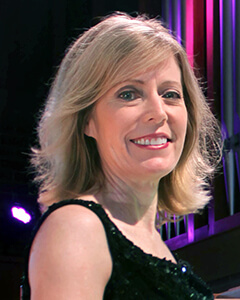
Dr. Lynnette Ball McGee has forged an active career as an organ recitalist, teacher, collaborative musician, and conductor. She is presently on the organ faculty at California State University, Fullerton, and is Music Director at First Presbyterian Church, Fullerton, where she conducts the Kirk Choir, Kirk Handbell Choir, and is principal organist.
As an organ recitalist, Lynnette has performed numerous concerts, including performances at First Congregational Church of Los Angeles, Renée and Henry Segerstrom Concert Hall, United Church of Christ, Claremont, and First United Methodist Church, Pasadena. Internationally, performance venues include the famed churches in Paris of St. Sulpice, St. Eustache, La Trinité, and St. Séverin, as well as the Basilica of Santa Maria del Coro in San Sebastian, Spain. Her collaborative work includes performances with the Aliso Viejo Symphony, California Concert Artists, Redondo Beach Baroque Festival, Corona del Mar Baroque Festival, Southern California Brass Ensemble, and university choirs and orchestras of Chapman University, Concordia University, Biola University, and Saddleback College. Her work with organist Dr. Brenda King Durden may be heard on the disc, Double Fantasy: Organ Duets.
Lynnette earned her Doctorate of Musical Arts from Claremont Graduate University where she was awarded a Music Fellowship and the CE and Bertha Harsh Fellowship. She also holds degrees in organ performance from California State University, Fullerton, where she graduated with highest honors and was inducted into the Phi Kappa Phi and Pi Kappa Lambda honor societies. Her organ teachers include Dr. Carey Robertson, Esther Jones, Dr. Frances Nobert, and Dr. Leslie Spelman.