

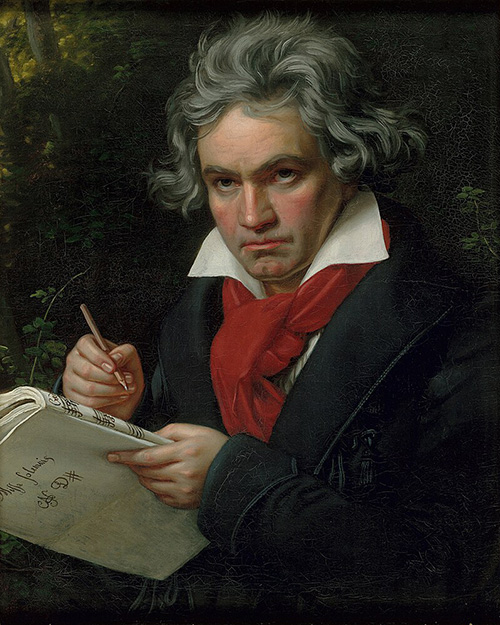
Image: Ludwig van Beethoven By Joseph Karl Stieler - Google Arts & Culture, Public Domain
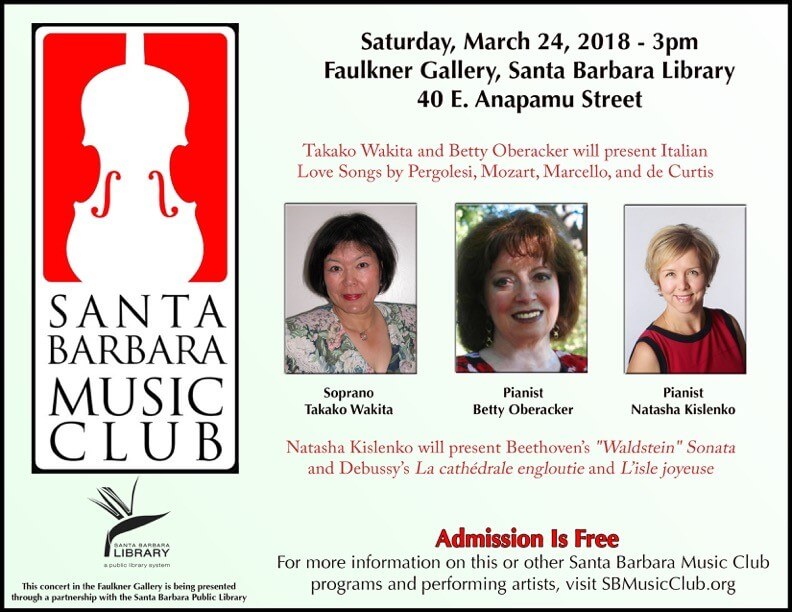
On Saturday, March 24 at 3 PM, the SANTA BARBARA MUSIC CLUB will present another program in its popular series of concerts of beautiful Classical music. The concert is presented in partnership with the Santa Barbara Public Library and will be held at the Faulkner Gallery in the Downtown branch of the library. Admission is free.
One of the highlights of Santa Barbara Music Club’s concerts is the opportunity for audiences to hear great music from a variety of historical periods, with a diversity of musical forms, performed by excellent artists. This concert features soprano Takako Wakita and pianist Betty Oberacker performing Italian Love Songs by Giovanni Battista Pergolesi, Wolfgang Mozart, Benedetto Marcello, and Ernesto de Curtis. Pianist Natasha Kislenko will close the program with Ludwig van Beethoven’s Sonata #21 in C Major, Op. 53 -“Waldstein” (1804) and Claude Debussy’s La cathedrale engloutie (1910) and L’isle joyeuse (1904).
Program Details
(1875-1937)
Betty Oberacker, piano
Notes on the Program
A leading figure in the rise of Italian comic opera in the 18th century, Giovanni Battista Pergolesi (1710-1736) was one of the most successful and respected composers of his generation. Se tu m’ami (If You Love Me) was first published in the late 1880s by Alessandro Parisotti, in a collection titled Arie antiche. Parisotti collected “antique arias” as part of a 19th century fad for discovering forgotten music from the Classical and Baroque eras. While Parisotti attributed the song to Pergolesi, no early manuscripts of the song have been located, leading some scholars to believe that Parisotti composed the piece himself.
While it may seem odd to see an Austrian composer represented in a set of Italian Love Songs, in the 18th century, Italian opera so dominated the genre that it attracted composers of every nationality. Wolfgang Amadeus Mozart (1756-1791), like many of his contemporaries, was as comfortable writing in the Italian language as in his native German. The Marriage of Figaro, premiered in 1786, was the first of three collaborations with the librettist Lorenzo da Ponte. Deh vieni, non tardar (Oh Come To me, Do Not Delay) is sung by the character of Susanna in Act IV of the opera.
The son of a Venetian nobleman, composer and writer Benedetto Marcello (1686-1739) followed the career path of all Venetian nobles of his time: he was admitted to the Maggior Consiglio (Great Council) of the Republic on December 4, 1706 and, after completing studies in literature and law, served in various magistracies over the next twenty years. Despite earning his living outside of music, he nonetheless was a major influence on Italian musical thought and performance throughout the 18th century, particularly through his psalm settings and cantatas. Quella fiamma che m’accende (That Flame That Ignites My Passion) is one of the latter.
Born in Naples, composer Ernesto de Curtis (1875-1937) studied piano and received a diploma from the Conservatory of San Pietro a Maiella in Naples. He wrote over 100 songs. Non ti scordar di me (Do Not Forget Me) was written in 1912.
Ludwig van Beethoven (1770-1827) was a German composer and performer who so successfully combined tradition, exploration, and personal expression that he came to be regarded as the dominant musical figure of the 19th century. Completed in 1804, the Waldstein Sonata set a standard for piano composition in the grand manner. Dedicated to Beethoven’s close friend and patron Count Ferdinand Ernst Gabriel von Waldstein, it is considered one of Beethoven’s greatest and most technically challenging piano sonatas.
Claude Debussy (1862-1918) was a French composer whose compositional innovations had a profound influence on generations of composers. Composed in 1910, La cathedrale engloutie (The Sunken Cathedral) is a musical depiction of an ancient Breton myth in which a cathedral, submerged underwater off the coast of the Island of Ys, rises up from the sea on clear mornings when the water is transparent. L’isle joyeuse (The Joyful Island) was composed in 1904 and was inspired by Watteau’s painting Embarkation for Cythere.
The Performers

Natasha Kislenko, pianist, was born in Moscow, holds graduate degrees from the Moscow Tschaikowsky Conservatory and Southern Methodist University (TX), and earned her DMA Degree from Stony Brook University (NY). She has concertized in Bulgaria, Germany, Italy, Russia, Spain, Turkey and the U. S., and has been prizewinner in piano competitions in both Europe and the U.S. Collaborative faculty member at the Music Academy of the West since 2004 and Principal Keyboard with the Santa Barbara Symphony since 2010, Dr. Kislenko is currently a Lecturer in the UCSB Department of Music.
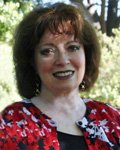
Betty Oberacker, pianist, is internationally acclaimed for her interpretations of both traditional and contemporary solo and chamber music repertoire, and has toured throughout Europe, Israel, Asia, Australia, New Zealand, Mexico and the U.S., including performances at Carnegie Hall, Amsterdam Concertgebouw, Berlin Philharmonic Hall and Vienna Musikverein. She has been Artist-in-Residence at 55 universities, conservatories and music festivals worldwide, and many important composers have dedicated their compositions to her. Her musical gifts were evidenced at three, when she began to play the piano and compose entirely by ear. Piano lessons started at age seven, and at nine she was accepted on scholarship as the only child student of the noted pianist Beryl Rubinstein. Her BM/MM Degrees are from the Cleveland Institute of Music, and her DMA Degree is from Ohio State University, where she was concomitantly a member of the piano faculty. Her discography includes Bach’s Well-Tempered Clavier (Clavier Records), A Bach Commemorative Recital (MIT Great Performances Archives), Chamber Music of Emma Lou Diemer (Orion), Schönberg’s Pierrot Lunaire (Century), John Biggs’ Variations on a Theme of Shostakovich (VMM), and Diemer’s Piano Concerto (MMC), the latter two works composed for Oberacker. Honors accorded her include a Fulbright Research Fellowship to Italy and the University of California Distinguished Teaching Award, and her students hold important positions as performers and teachers in the U.S., Asia and Europe. Dr. Oberacker is UCSB Professor Emeritus, and enjoys an active performing, teaching and chamber music coaching schedule.
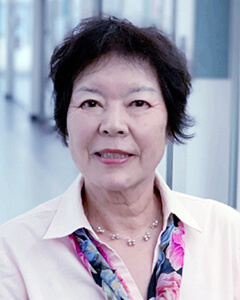
Takako Wakita, soprano, has appeared in both concerts and operas in the U. S. and abroad, including Madama Butterfly with the Japanese Philharmonic at Dorothy Chandler Pavilion in Los Angeles. She has also sung with Opera Santa Barbara, the Pacific Music Society, SB Choral Society, SB Civic Light Opera, and Ventura College Opera. She earned her BA Degree from Kyoiku University and her MA Degree from UCSB. Founder and current faculty member of the Japanese Language Program at SBCC, Professor Wakita also teaches for the SBCC School of Extended learning, is Chair of the Santa Barbara Sister Cities Board, and serves on the board of the Toba Sister City Organization, which promotes Japanese culture in Santa Barbara and sponsors a student exchange.
This concert in the Faulkner Gallery is being presented through a partnership with the Santa Barbara Public Library.